Javier Vilató’s style:
Though Vilató’s art inevitably recalls that of his famous uncle, Pablo Picasso, particularly in his handling of the female figure, he nevertheless managed to develop a drawing style that is distinctively his own.
He endows his female nudes and bathers with a sense of lightness, whimsy and sensuality that is not often seen in the much crueler end incisive art of Pablo Picasso. Over the course of his career Vilató preserved a sense of freshness in his work and also a carefully calibrated child-like quality that infuses his prints with a send of lightheartedness and good humor. His use of line is rhythmical and dance-like and emphasizes the liveliness and energy of his figures as well as the bright, sonorous luminosity of their Mediterranean environment.
Catégorie : Vilató
-
Artwork
-
Public Collections
Musée des Beaux Arts, Caen, France.
Céret Museum, Céret France.
Epinal Museum, Epinal, France.
Musée des Beaux Arts, Limoges, France.
Bibliothèque Nationale, Paris, France.
Centre Georges Pompidou, Paris, France.
Contemporary National Art Collection, Paris, France.
Mobilier National, France.
Contemporary Art Collection, Orne, France.
Museum of Modern Art, New York, NY, USA.
Museum of Fine Arts, Boston, MA, USA.
Yale University, New Haven CT, USA.
Johannesburg Museum, Johannesburg, South Africa.
Vila Casas Foundation, Barcelona, Spain.
Reina Sofia Museum, Madrid, Spain.
Telefónica Foundation, Madrid, Spain.
Spanish Museum of Contemporary Engraving, Marbella, Spain.
Cadaqués Museum, Cadaqués, Spain.
Cuenca Museum, Cuenca, Spain.
Las Palmas Museum, Gran Canaria, Spain.
Valls Museum, Valls, Spain.
Benaki Museum, Athens, Greece.
Alexandre Soutzos National Gallery, Athens, Greece.
Municipal Gallery, Athens, Greece.
Municipal Art Gallery, Thessaloniki, Greece.
Jerusalem Museum, Jerusalem, Israel.
Halsingland Museum, Hudiskvall, Sweden.
Yverdon Municipal Collections, Yverdon, Switzerland.
Neuchâtel History and Fine Arts Museum, Neuchâtel, Switzerland. -
Personal Exhibitions
2012
Joan Gaspar Gallery, Madrid, Spain.
« Vilató, Barcelona-París. The Road to Freedom », A homage from the city of Barcelona, Picasso Museum, Barcelona, Catalonia, Spain.
« Coses », Sala Dalmau Gallery, Barcelona, Catalonia, Spain.
« En bronze », Marès Museum, Barcelona, Catalonia, Spain.
« Bestiones », Vila Casas Foundation, Barcelona, Catalonia, Spain.
« En paper », Joan Gaspar Gallery, Barcelona, Catalonia, Spain.2005
Vilató, de Barcelona a París, Vila Casas Foundation, Barcelona, Spain.2003
House of Catalonia, Paris, France.
Cervantes Institute, Paris, France.2001
« Vilató escultor », Telefónica Arte y Tecnología Foundation, Madrid, Spain.
Inauguration of grand copper relief, Funicular railway station, Neuchâtel, Switzerland.2000
Episcopal Palace, Malaga, Spain.
Santa Inés Convent, Seville, Spain.1999
Château de Carrouge. Office Départemental de la Culture de l’Orne. Orne, France.
Goya Museum, Castres,. Tarn, France.
« Exposición homenaje 1938-1999 », Sala Dalmau Gallery, Barcelona, Catalonia, Spain.1998
ESTAMPA 98 (sculptures), Madrid, Spain.1997
Galerie Carmen Héritier, Mirmande, France.1996
Print exhibition, Galerie La Fenêtre, Paris, France.1995
« Vilató en las colecciones europeas », Telefónica Arte y Tecnología Foundation, Madrid, Spain.1994
Print exhibition, Artothèque, Nice, France.
Print exhibition, Spanish Museum of Contemporary Engraving, Marbella, Spain.1993
Tiziano Gallery, Alicante, Spain.
Galerie Lina Davidov, Paris, France.
Print exhibition, Estiarte Gallery, Madrid, Spain.1992
Goya Gallery, Zaragoza, Spain.
Galerie Saint-Rémy, Meaux, France.1990
Moulin de Fombeton, Sisteron, France.1989
Print exhibition, Office Départemental de la Culture, Aix-en-Provence, France.
Print exhibition, Fauna’s Gallery, Madrid, Spain.
Jaime Gea Gallery, Alicante, Spain.
Print exhibition, Richard am Bleicherweg Gallery, Zurich, Switzerland.1988
Fauna’s Gallery, Madrid, Spain.1986
Christopher Hull Gallery, London, England.1985
La Maison de la Gravure au Marais, Paris, France.1984
Print exhibition, Rufino Tamayo Museum, Mexico City, Mexico.1982
Château des Antiquaires, Allaman, Switzerland.
Kogal Gallery, Bern, Switzerland.
Galerie La Lisière, Reims, France.1980
Print exhibition, Galerie Sagot – Le Garrec, Paris, France.
Hôtel de Ville, Yverdon, Switzerland.1979
Institut Malherbe, Caen, France.1978
Print exhibition, Lorensbergs Konstsalong, Gothenburg, Sweden.
Galerie Sagot – Le Garrec, Paris, France.1977
Galax Gallery, Gothenburg, Sweden.
Galerie Berggruen, Paris, France.
Print exhibition, Charles Manchen Gallery, Luxemburg.1976
Ditesheim Gallery, Neuchatel, Switzerland.1975
Kända Malare Gallery, Skovde, Sweden.
Skira Gallery, Madrid, Spain.1974
Print exhibition, Galerie Sagot – Le Garrec, Paris, France.
Sapone Gallery, Nice, France.1973
Vastergotland Museum, Skara, Sweden.1972
Varberg Museum, Varberg, Sweden.
Halsingland Museum, Hudisksvall, Sweden.1971
Print exhibition, Ariane gallery, Gothenburg, Sweden.
Fondation Grand Cachot de Vent, La Brévine, Switzerland. Catalog preface by Denys Chevalier.
Print exhibition, Arkitekgarden, Laholm, Sweden.1970
Uppsala University, Uppsala, Sweden.
Copper reliefs, Skira Gallery Madrid, Spain.
Ariane Gallery, Gothenburg, Sweden.
Halsingland Museum, Hudiksvall, Sweden.
Ariane Gallery, Stockholm, Sweden.1969
Ariane Gallery, Gothenburg, Sweden.
Chapelle des Moulins, Fleurier, Switzerland.
Great copper relief 3 x 8 meters – Sala de reuniones de Peñarroya, Paris, France.1968
Print exhibition, Contemporary art Museum, Madrid, Spain.1966
Print exhibition, Syra Gallery, Barcelona, Spain.
Fondation Maeght, Saint-Paul-de-Vence, France.
Numaga Gallery, Auvernier, Switzerland.1965
Print exhibition, Bibliothèque Nationale, Paris, France.1964
Print exhibition, Galerie Sagot – Le Garrec, Paris, France.
Syra Gallery, Barcelona, Catalonia, Spain. Catalog preface by Juan Ainaud de Lasarte.
Biosca Gallery, Barcelona, Catalonia, Spain. Catalog preface by Juan Ainaud de Lasarte.
Merlin Gallery, Athens, Greece. Catalog preface de André Verdet.1963
Findley Galleries, Chicago IL and Palm Beach FLA, USA.
Galerie Jeanne Castel, Paris, France.
Grand Hôtel, Juan-les-Pins, Juan-les-Pins, France).1962
Zygos Gallery, Athens, Greece.1961
Print exhibition, Renée Ziegler Gallery, Zurich, Switzerland. Catalog preface by Manuel Gasser.1960
Galerie des Etats-Unis, Cannes, France. Catalog preface by Jacques Lassaigne.1959
Galerie L’Elysée, Paris, France. Catalog preface by Douglas Cooper.1958
Galerie des Nouveaux Grands Magasins, Lausanne, Switzerland. Catalog preface by Georges Peillex.1957
Print exhibition, Nicolas Rauch Gallery, Geneva, Switzerland. Poem by Jacques Prévert in catalog.1956
Print exhibition, Maurice Bridel i Nane Cailler Gallery, Lausanne, Switzerland.
Galerie Jeanne Castel Gallery, Paris, France.
Hôtel Baron Guy de Rothschild, Paris, France.
Galerie 65, Cannes, France.1955
Print exhibition, Galerie Guilde de la Gravure, Paris, France.1954
Galerie Jeanne Castel, Paris, France.
Del Capitole Gallery, Lausanne. Catalog preface by Raymond Cogniat.1952
Galerie Jeanne Castel, Paris, France.1951
Galerie 55, Paris, France.1950
Print exhibition, Editions G.L.M), Paris, France.1948
Galerie Pierre, Paris, France.1946
Galerie Breteau, Paris, France.1945
Pictoria Gallery, Barcelona, Catalonia, Spain. -

About
Catalonian/Spanish, nephew of Pablo Picasso.
Born 1921 in Barcelona, died 2000 in Paris.Javier Vilató was a nephew and close companion of Pablo Picasso. He is the son of Picasso’s sister Lola and the Catalan neuro-psychiatrist, Joan Baptista Vilató. He was all his life very close to his celebrated uncle and was a key player in Picasso’s decision to make a major donation of his works to the city of Barcelona in 1970, now housed in the Picasso museum in Barcelona.

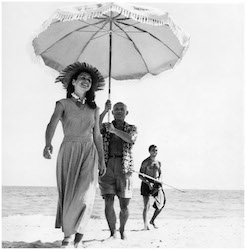
Pablo Picasso, Francoise Gilot and Javier Vilato in Cannes, 1951, by Robert Capa.A Catalan born and bred, Vilató enjoyed a long and successful career in Paris, Spain and in many European venues. His work is to be found in the collections of major international museums including the Centre Pompidou in Paris, MoMA in New York, Reina Sofia in Madrid, the Jerusalem Museum in Israel and the Benaki museum in Athens. He has been described as « Barcelonan by birth, an Andalusian by sensibility and a Parisian by adoption. »
At the end of the Spanish Civil War in 1939 he crossed the frontier into France where he was held with other Spanish refugees at the concentration camp of Argelés. His uncle Pablo Picasso managed to get him out, and the young man then settled briefly in Paris until the beginning of the Second World War. After the outbreak of war he moved back to Barcelona where he began painting and exhibiting in the 1940s.
A grant from the French government, enabled Javier Vilató to settle definitely in Paris in 1946. He became a fixture of the post-war Paris art scene exhibiting regularly in all the major salons. At the beginning of the 1950s Javier Vilató started experimenting with printmaking, a technique that, over the years, became as important to him as painting. He worked on numerous limited illustrated editions of authors such as Federico Garcia Lorca, Claude Roy, Andrée Chedid and Antonio Porchia.

Javier Vilato in his Blvd. Raspail studio in 1989.During the 1950s and 1960s, his work gained international exposure in gallery exhibitions in Barcelona, Geneva, London and Turin. His work was also shown at the National Library in Paris and the Spanish Museum of Contemporary art in Madrid. At the end of the 1960s Javier Vilató was recognized as a major Paris engraver and invited to join the Societé des Peintres Graveurs Français. In the same period he also worked as a sculptor and on important ceramic mural commissions.
In the following three decades from 1970 until his death in 2000 the work of Javier Vilató received wide international recognition with exhibitions in museums, foundations and galleries in Switzerland, Mexico, France, Spain, Italy, Luxemburg, England and Sweden.