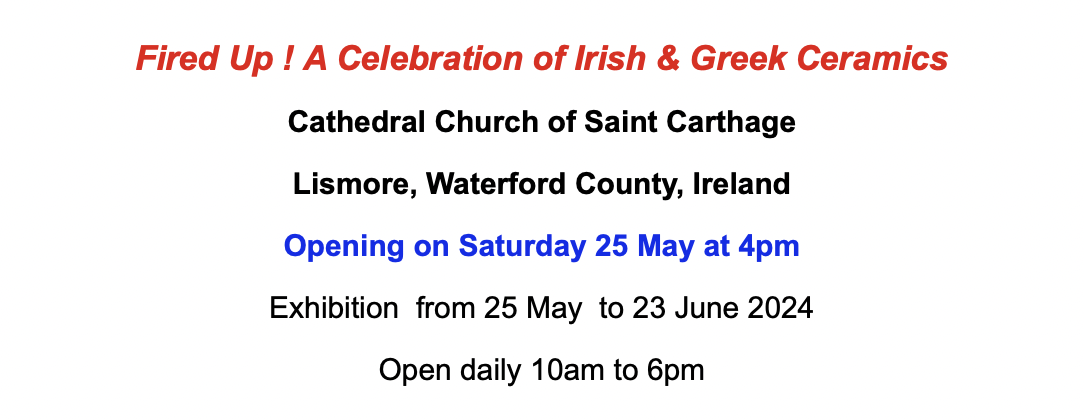
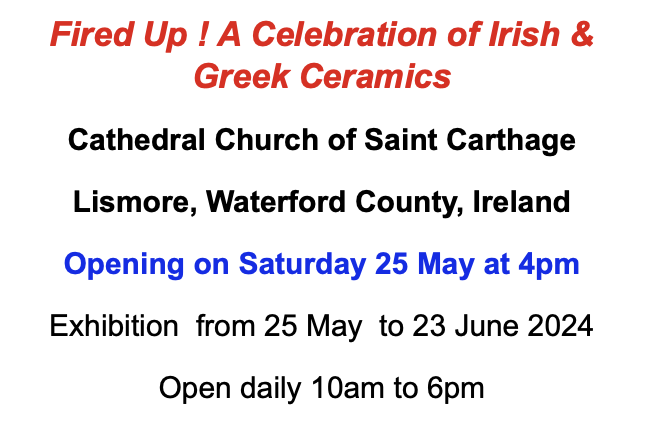
Fired Up ! A Celebration of Irish & Greek Ceramics
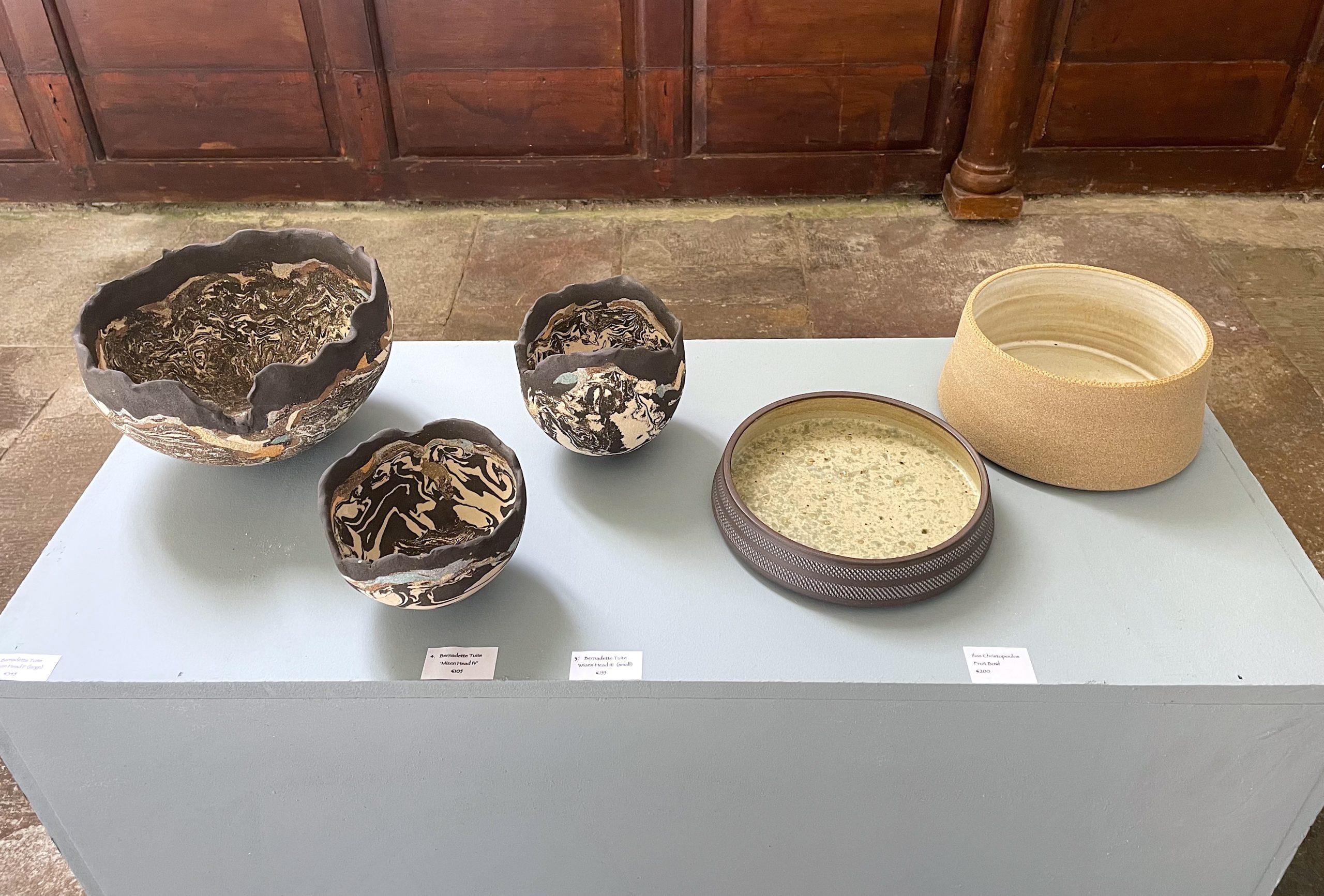
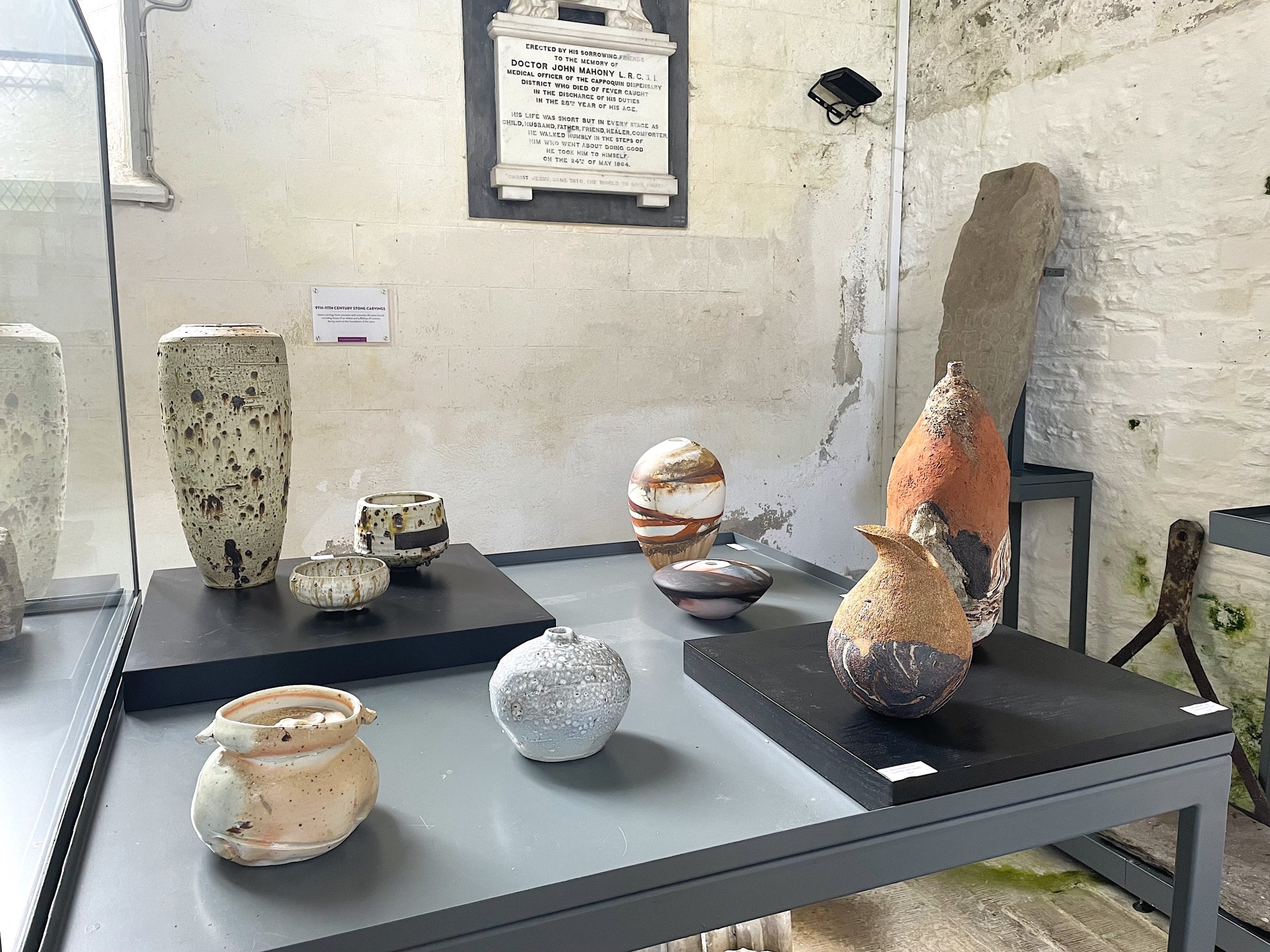
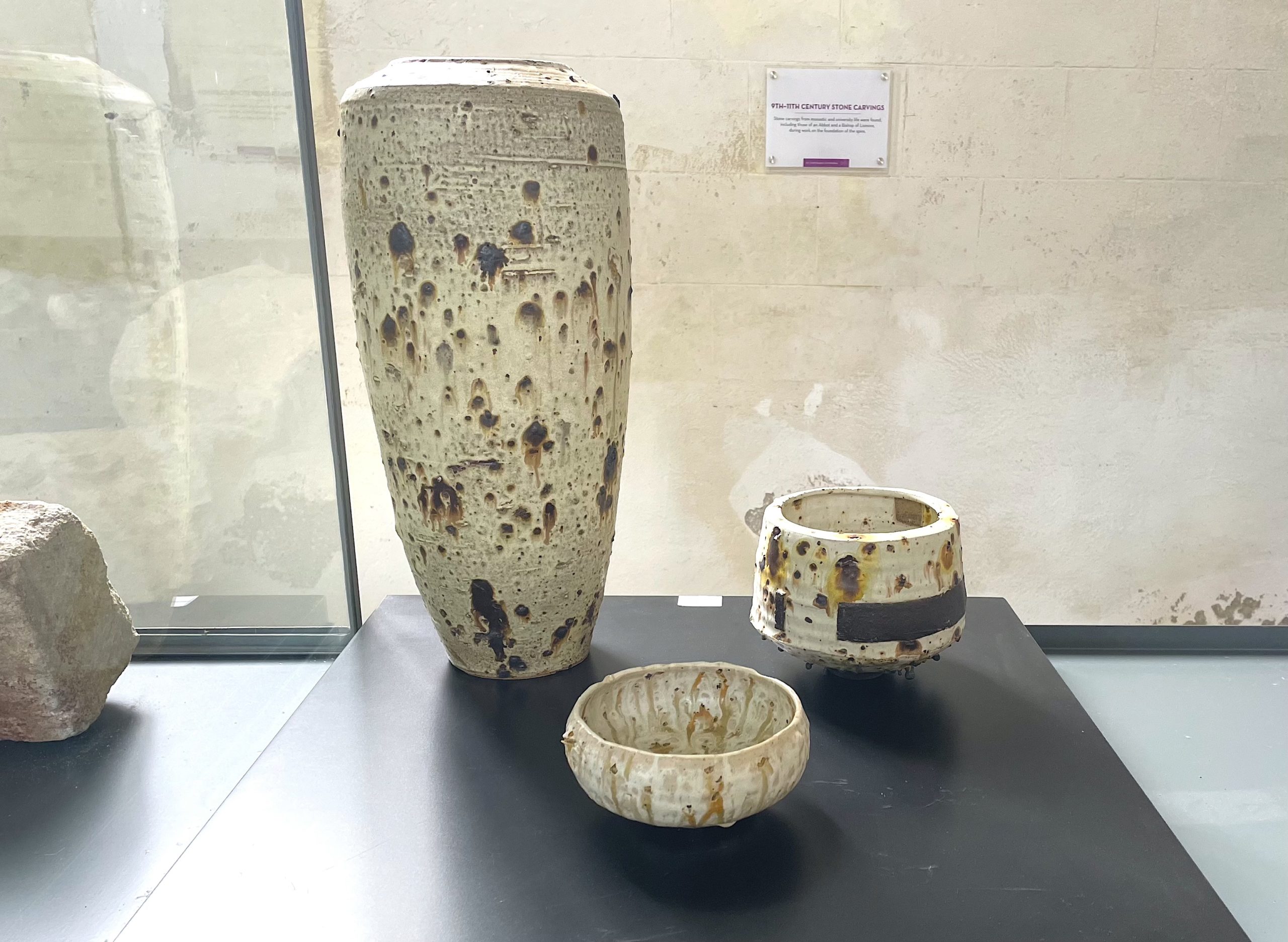
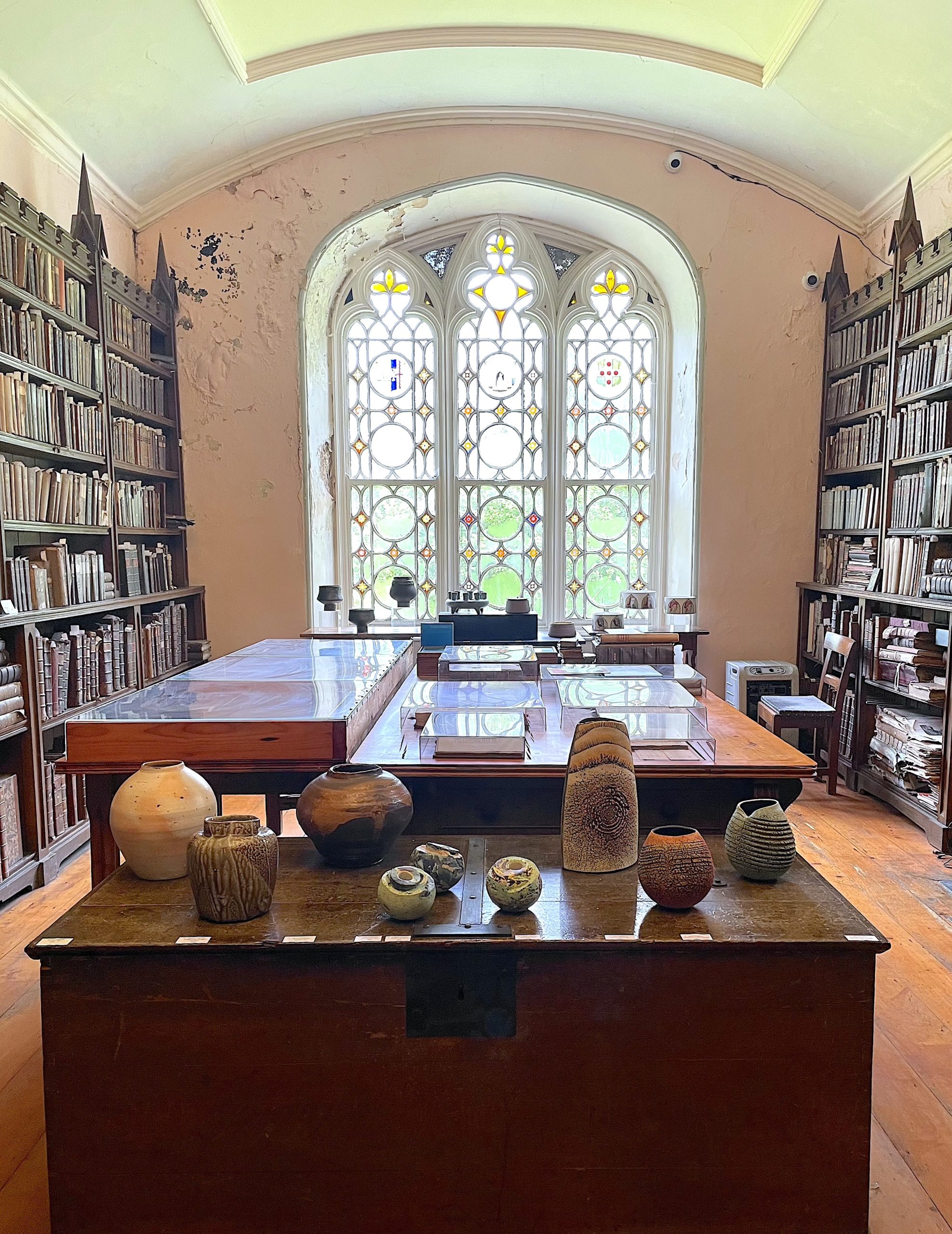
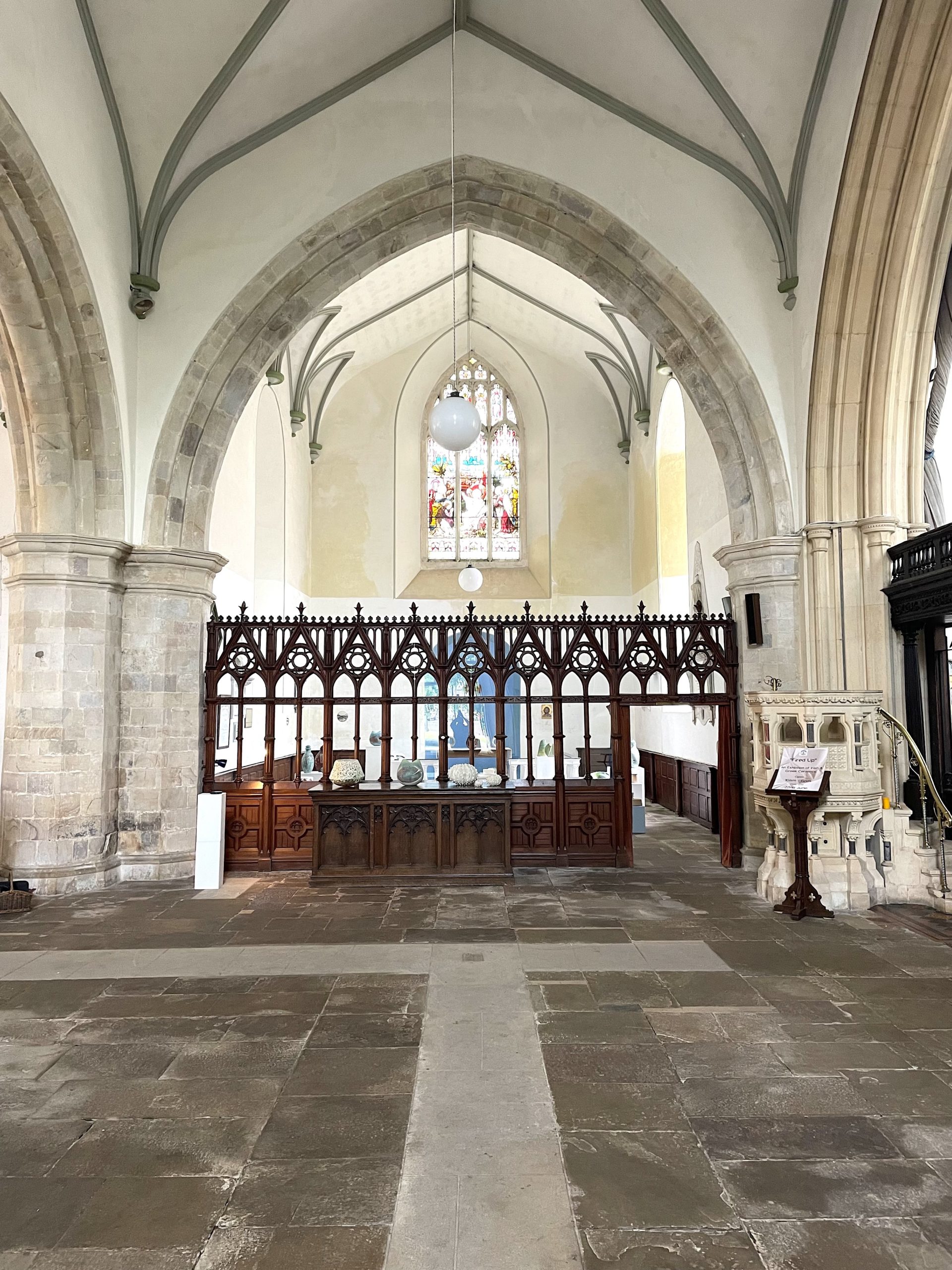
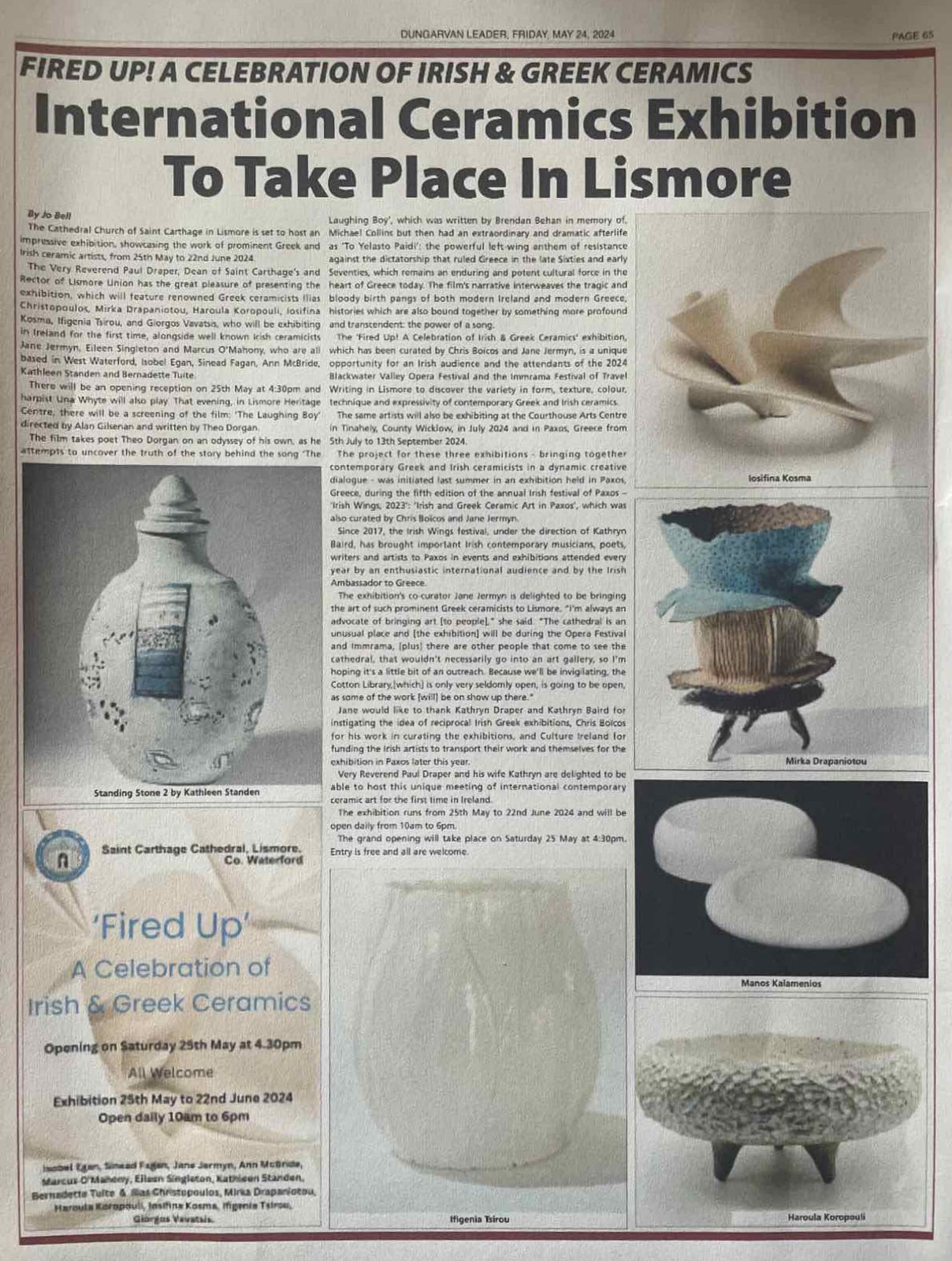
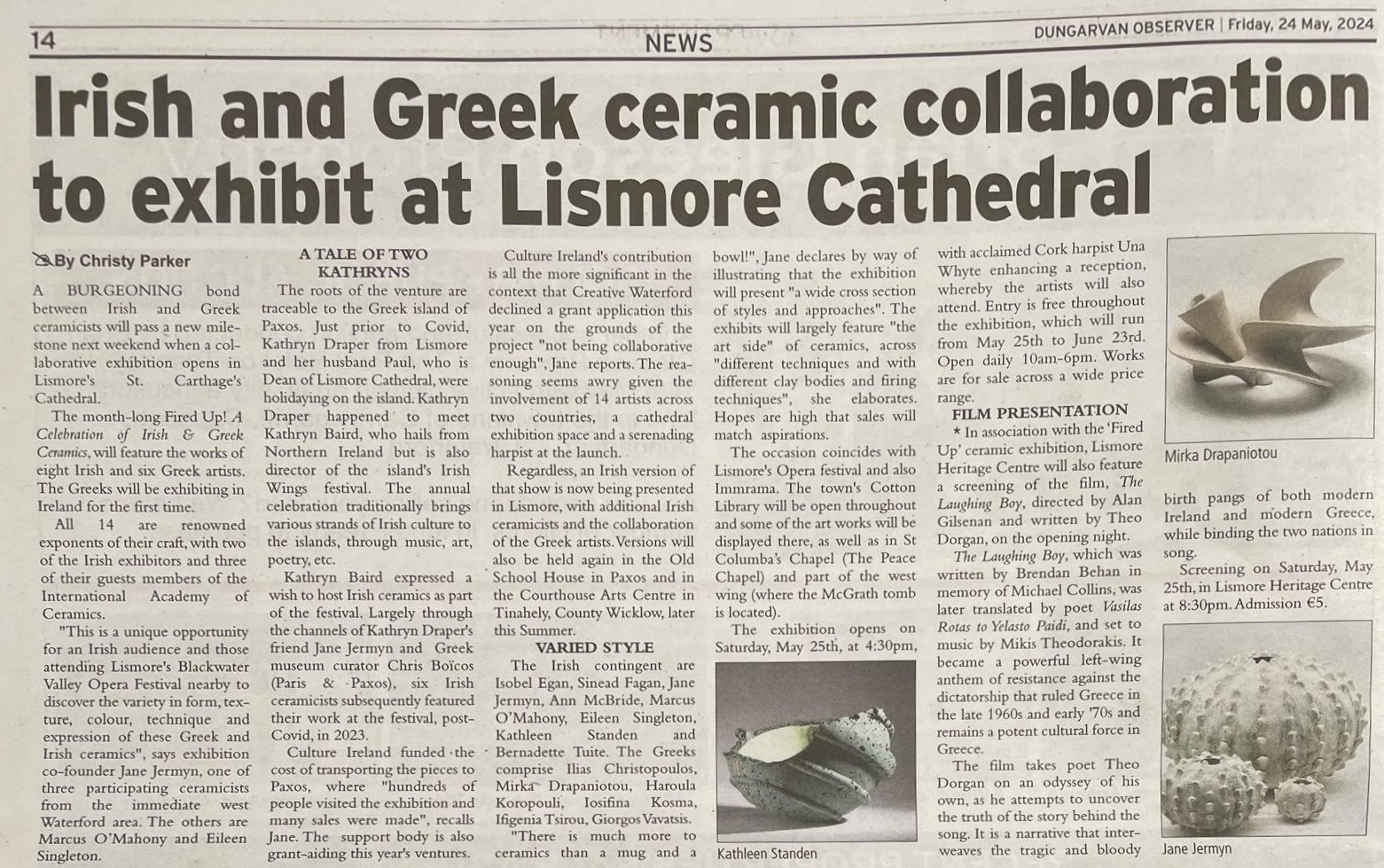
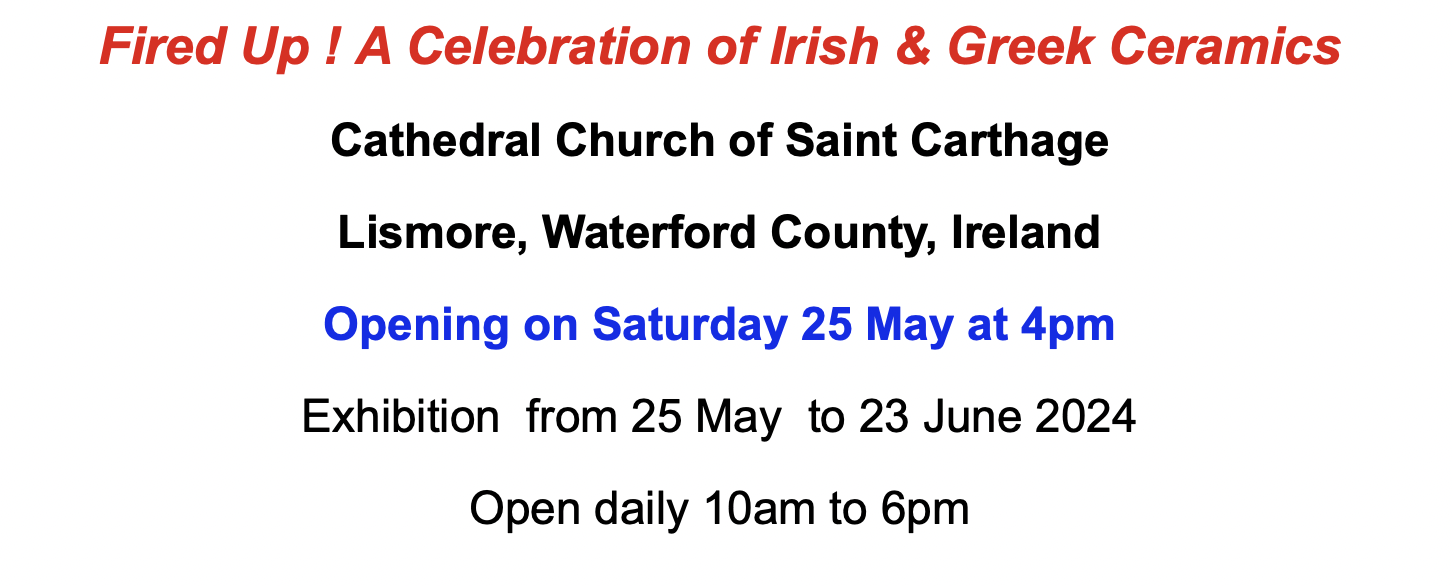
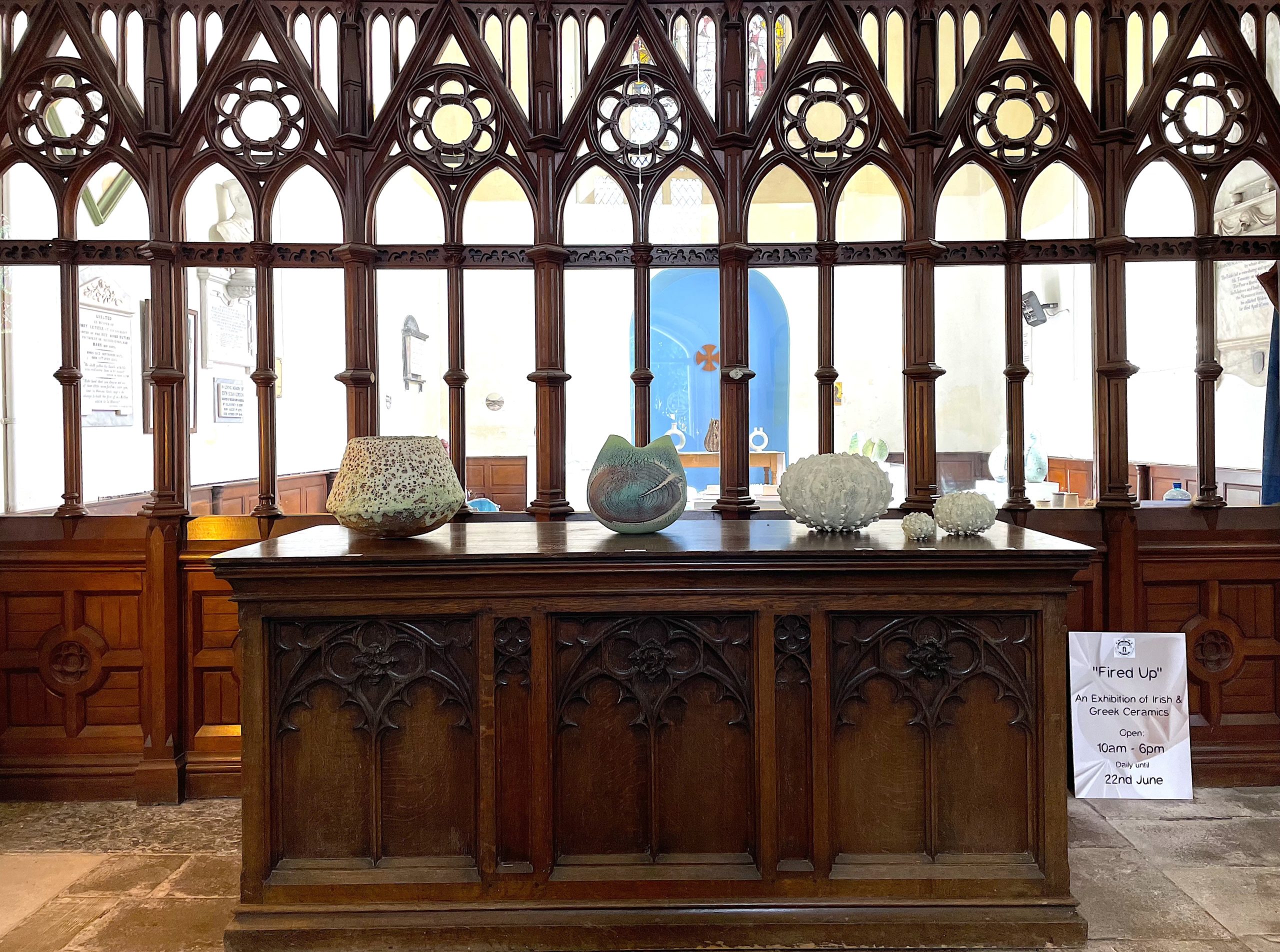
The Very Reverend Paul Draper, Dean of Saint Carthage’s & Rector of Lismore Union has the great pleasure of presenting at Saint Carthage Cathedral in Lismore six prominent Greek ceramicists – Ilias Christopoulos, Mirka Drapaniotou, Haroula Koropouli, Iosifina Kosma, Ifigenia Tsirou, Giorgos Vavatsis – who are exhibiting in Ireland for the first time.
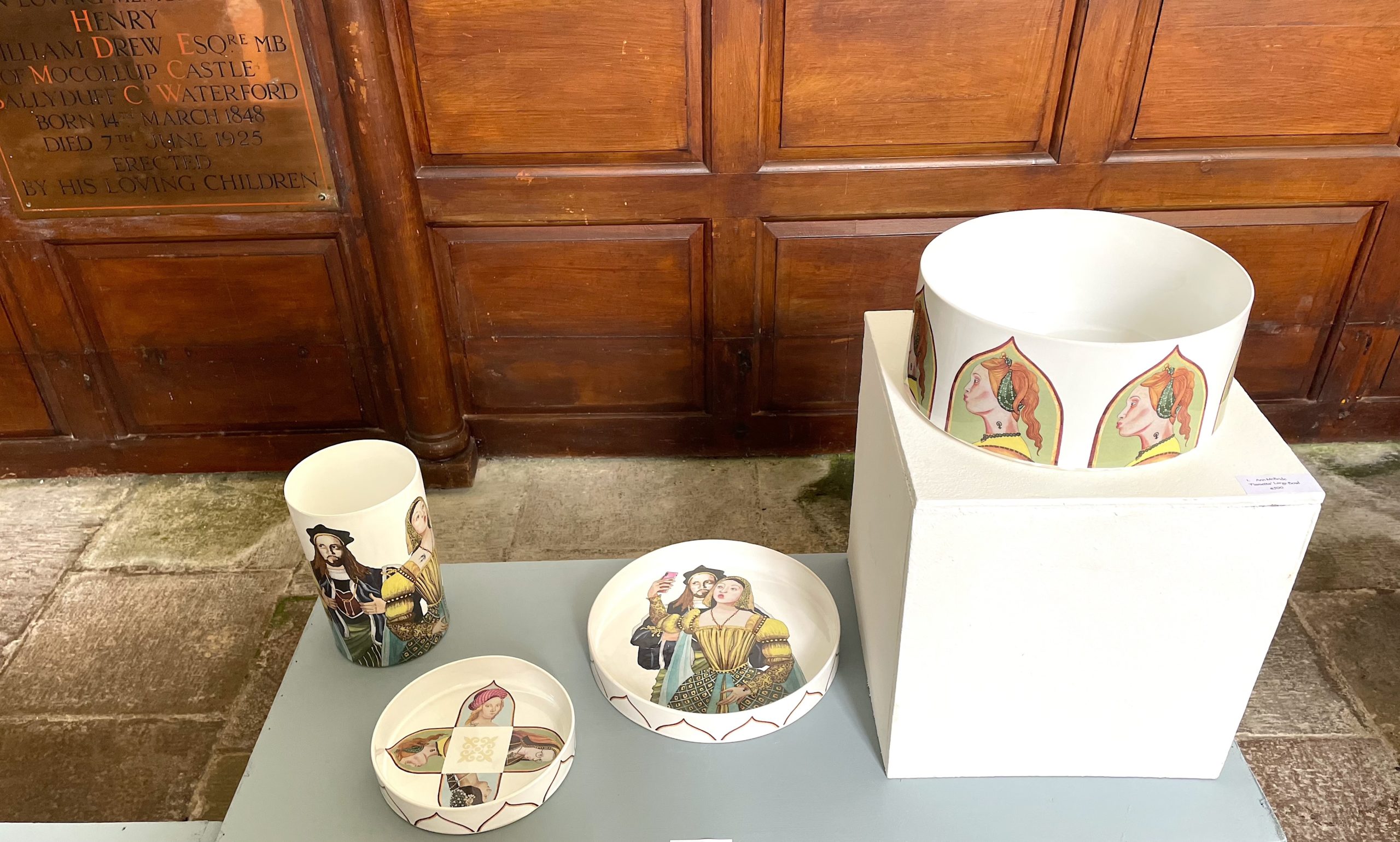
Our Greek guests will be exhibiting in the company of eight well-known Irish colleagues: Isobel Egan, Sinead Fagan, Jane Jermyn, Ann McBride, Marcus O’Mahony, Eileen Singleton, Kathleen Standen & Bernadette Tuite.
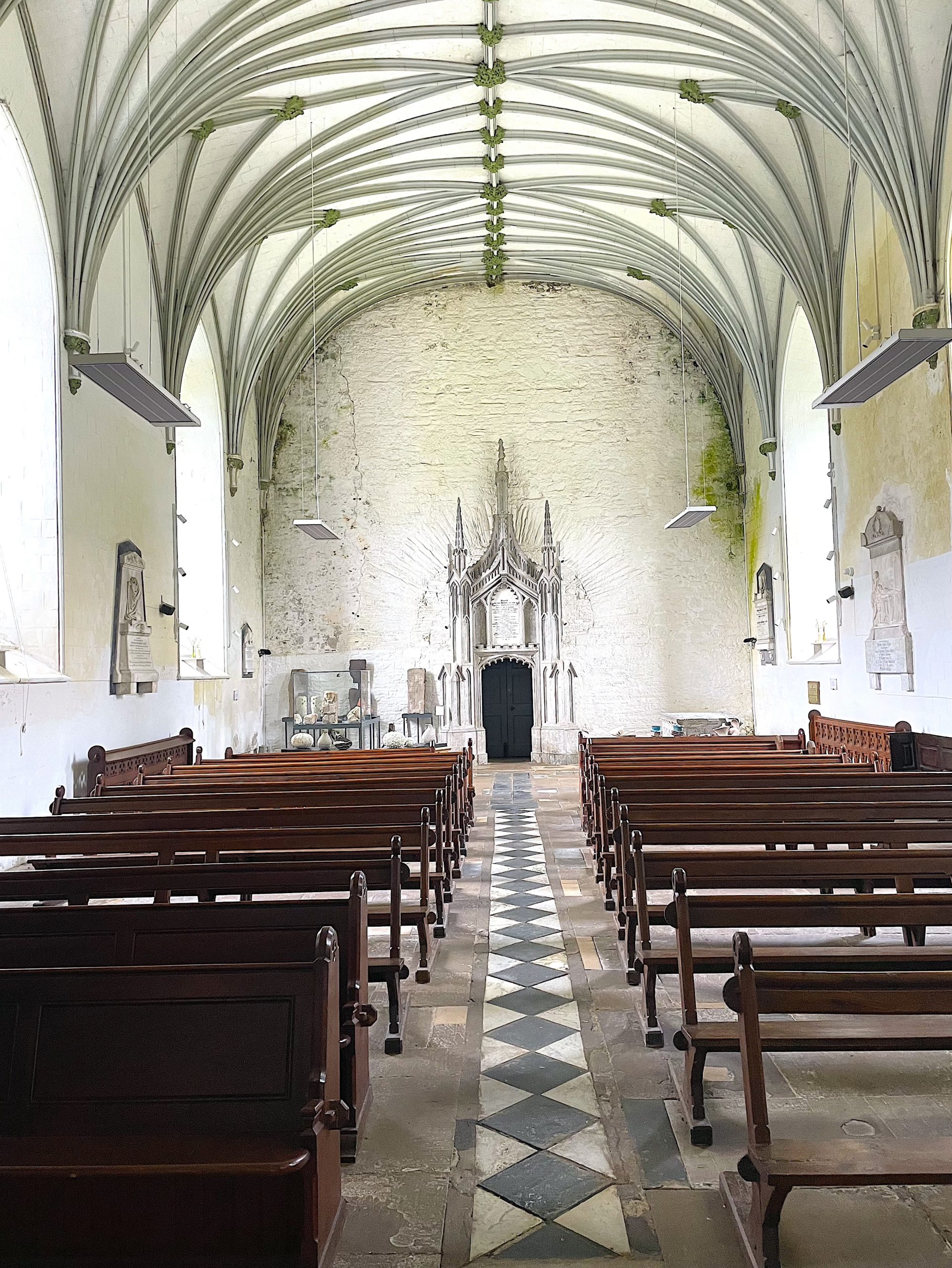
The Saint Carthage Cathedral in Lismore:
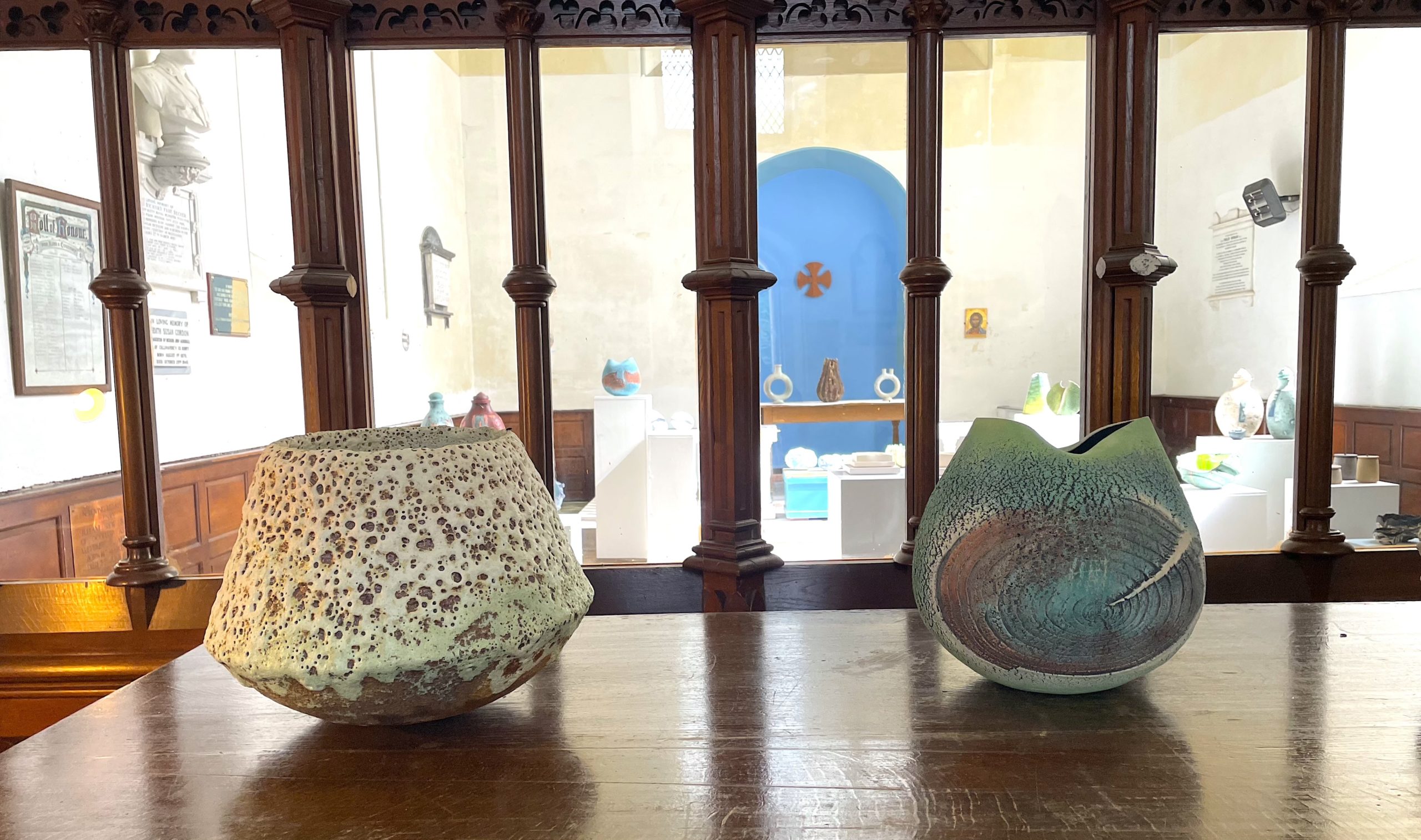
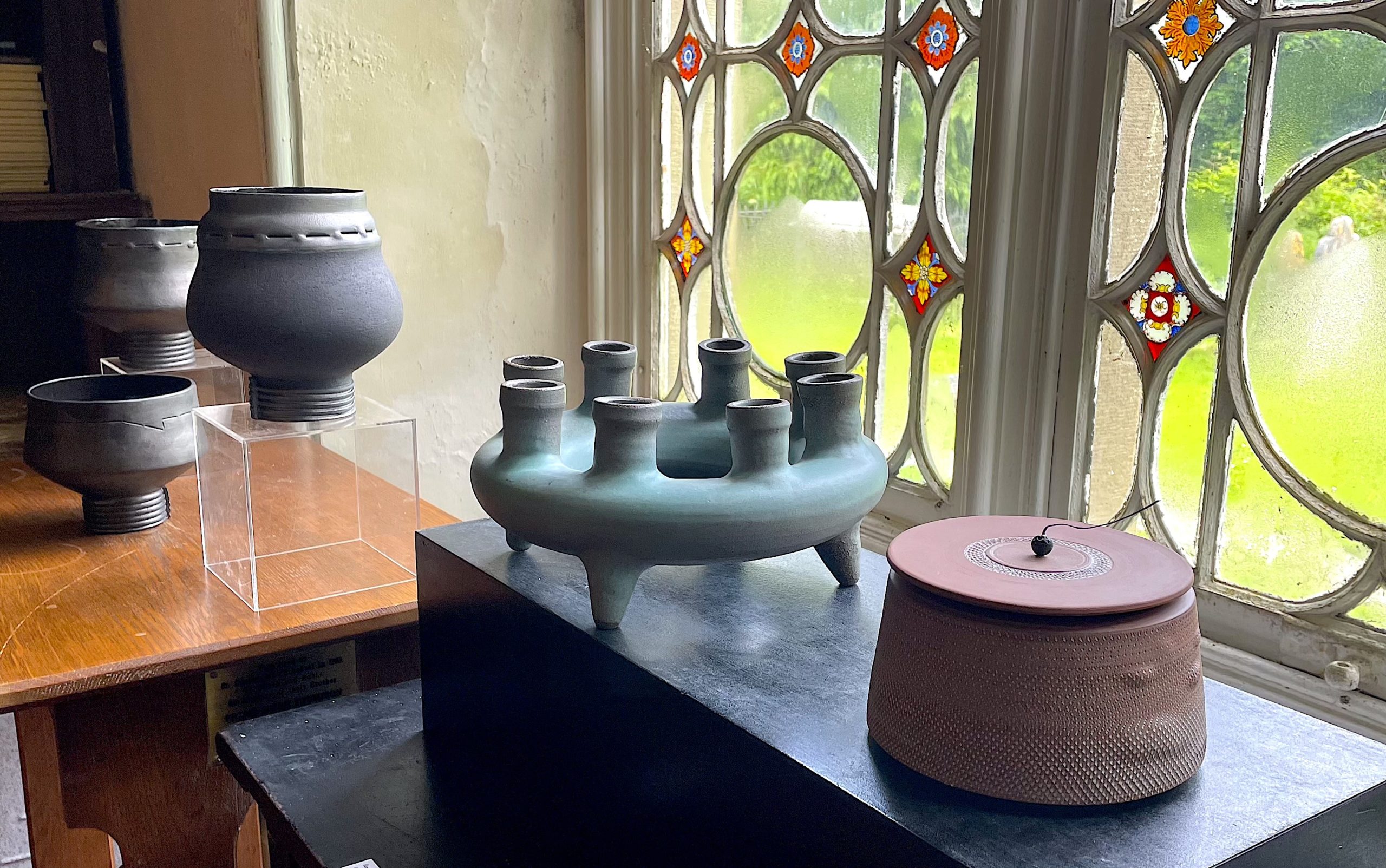
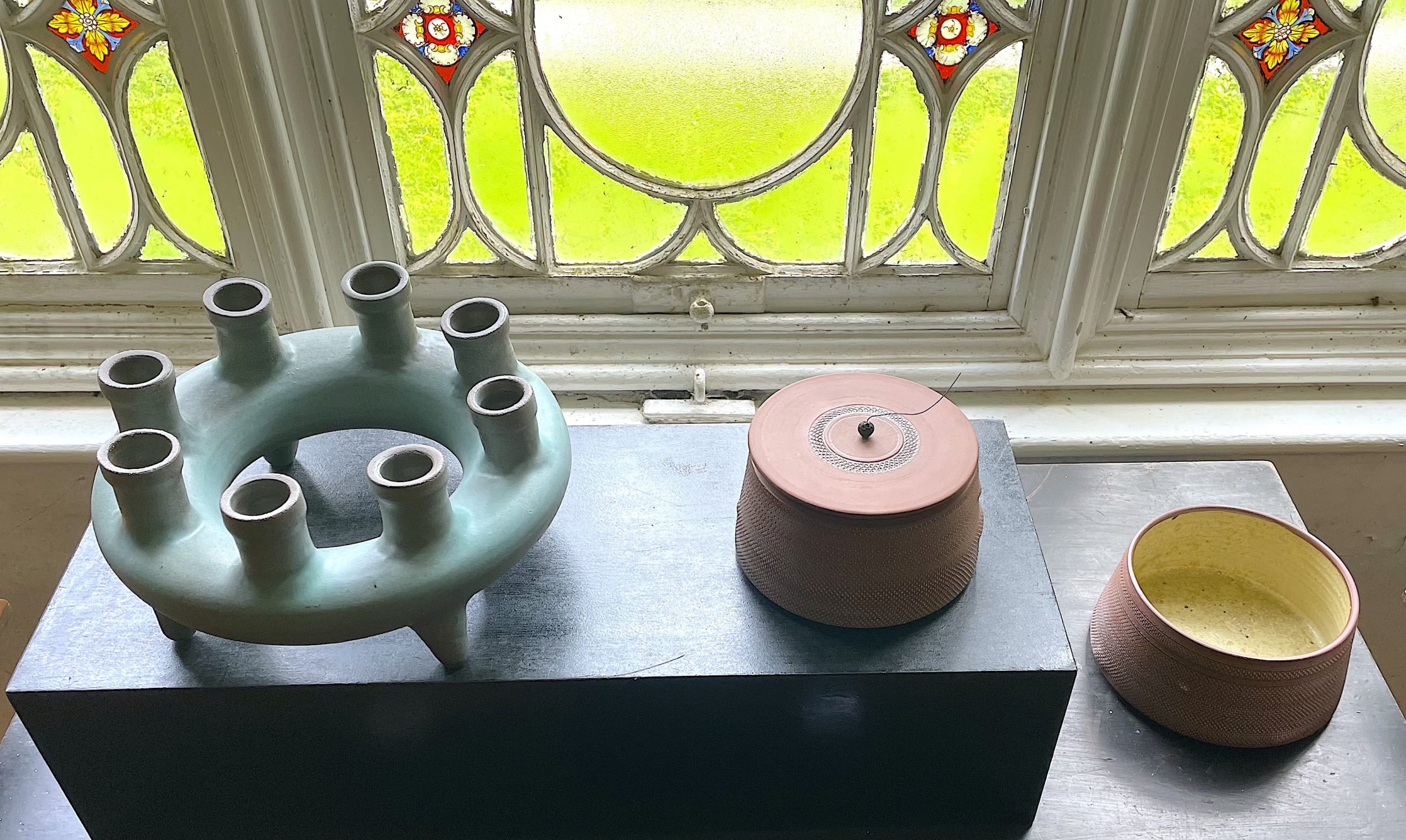
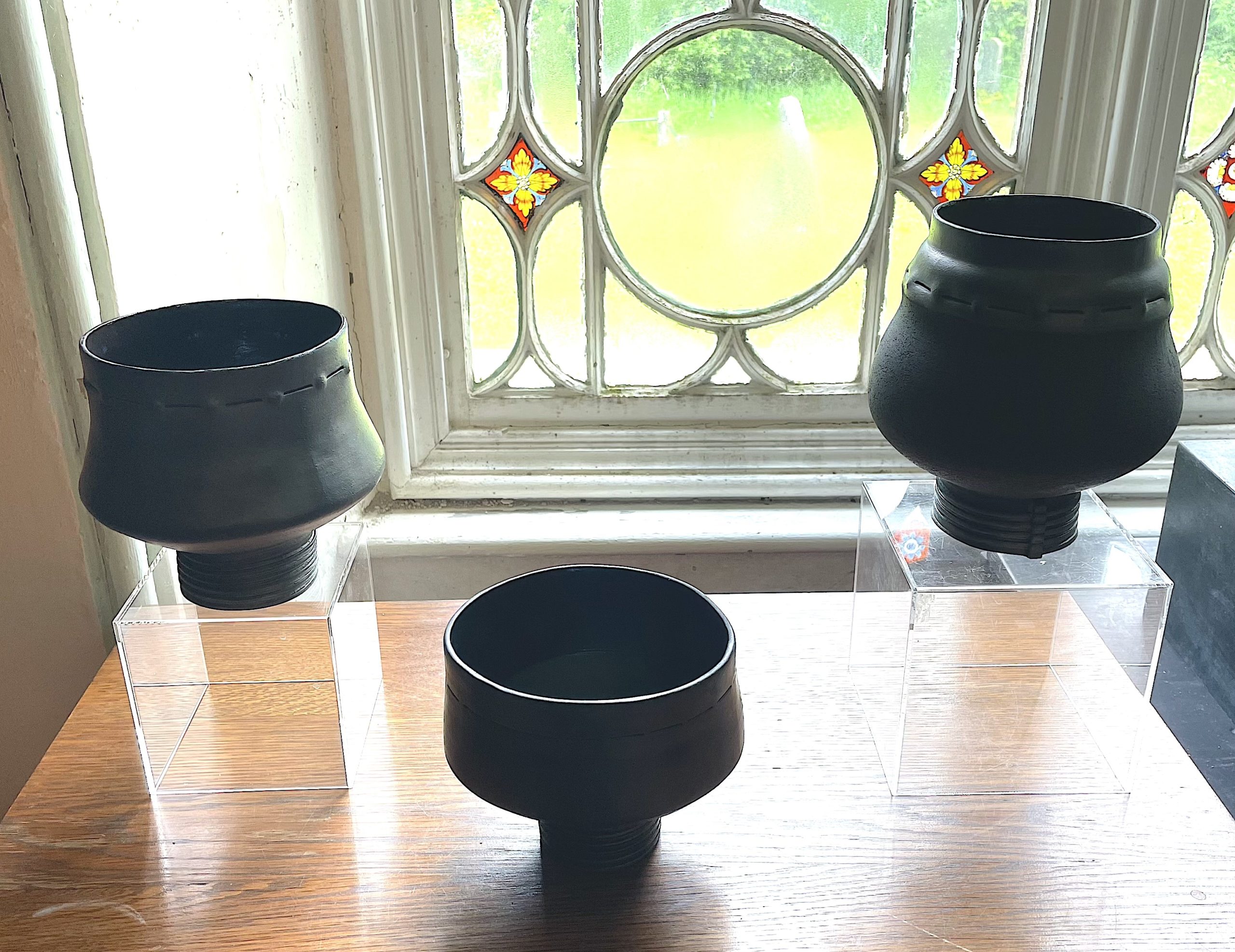
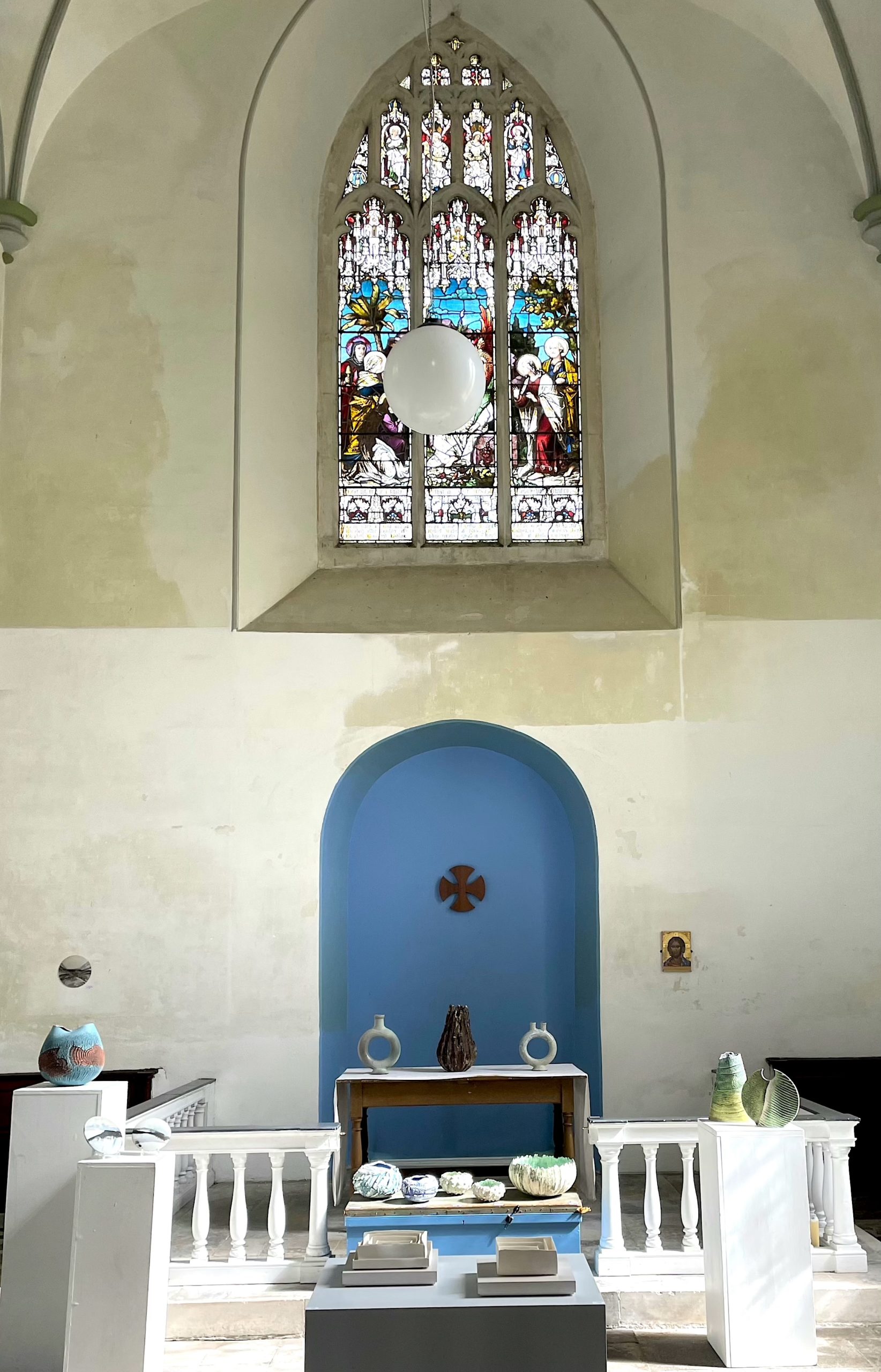
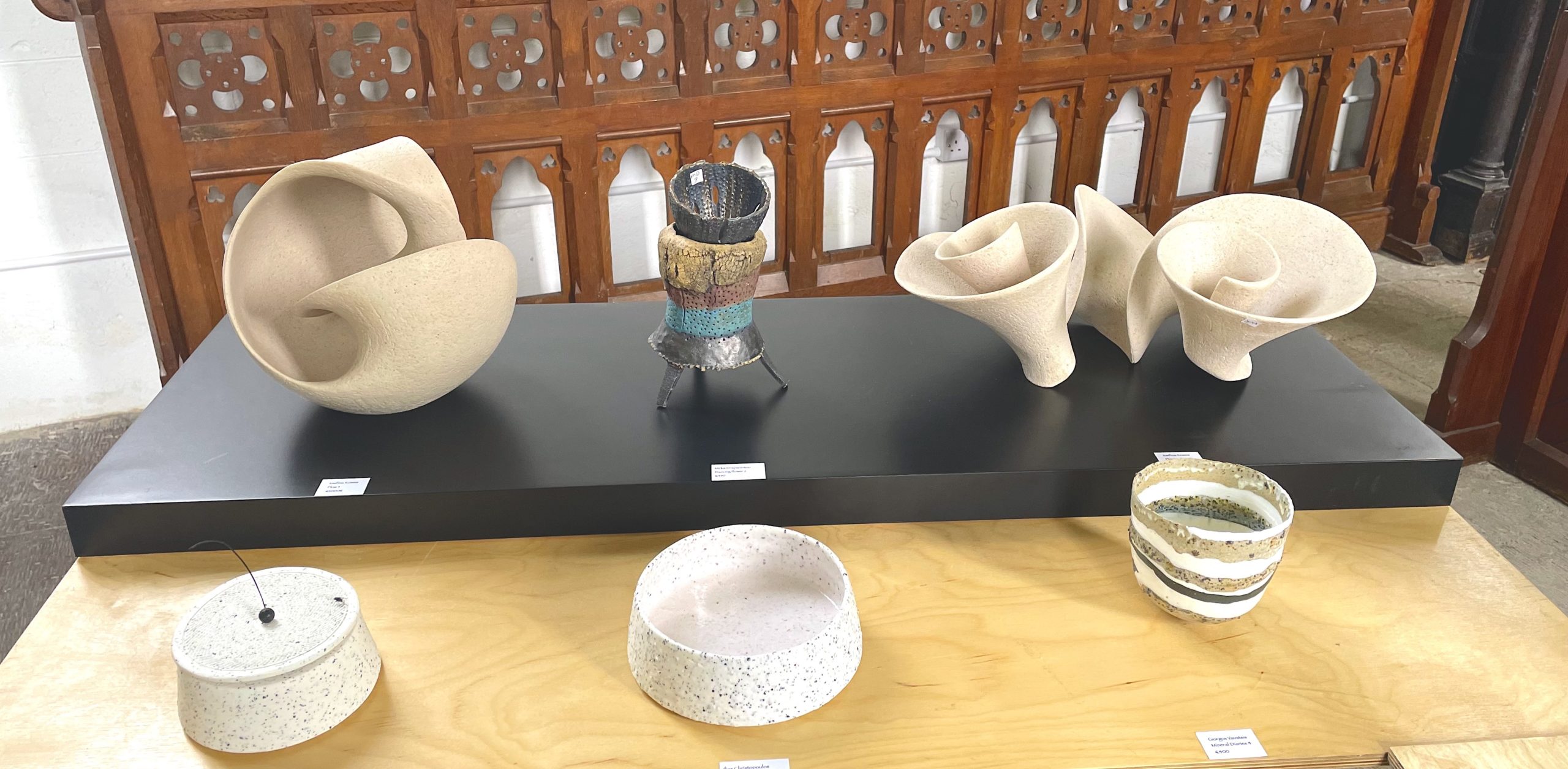
This is a unique opportunity for an Irish audience and the attendants of the 2024 Blackwater Valley Opera Festival in Lismore to discover the variety in form, texture, colour, technique and expressivity of contemporary Greek ceramics.
The same artists will also be exhibiting at the Courthouse Arts Centre in Tinahely, County Wicklow, in July 2024 and at the Old Schoolhouse of Loggos in Paxos, Greece from 5 July to 18 August 2024.
The project for these three exhibitions – bringing together contemporary Greek and Irish ceramicists in a dynamic creative dialogue – was initiated last summer in an exhibition held in Paxos, Greece during the fifth edition of the annual Irish festival of Paxos – Irish Wings, 2023: Irish and Greek Ceramic Art in Paxos curated by Chris Boïcos and Jane Jermyn.
Since 2017 the Irish Wings festival, under the direction of Kathryn Baird, has brought important Irish contemporary musicians, poets, writers and artists to Paxos in events and exhibitions attended every year by an enthusiastic international audience and by the Irish Ambassador to Greece.
We are delighted to be able to host this unique meeting of international contemporary ceramic art for the first time in Ireland.
Ilias Christopoulos is based in Kalamata in the southern Peloponnese. He is a very active member and well-known teacher of the artistic ceramic community in Greece, organizer of symposia and contemporary ceramic art group exhibitions, notably in the archeological museums of Delphi, Patra and Messenia. He is co-founder with Haroula Koropouli of the ceramic artists association “Kerameon Ihni” (“Ceramic Traces”) based in Patra in the Peloponnese. His work has been widely exhibited in Greece and abroad, notably in Italy, Spain, Austria, Hungary, Slovenia and France.
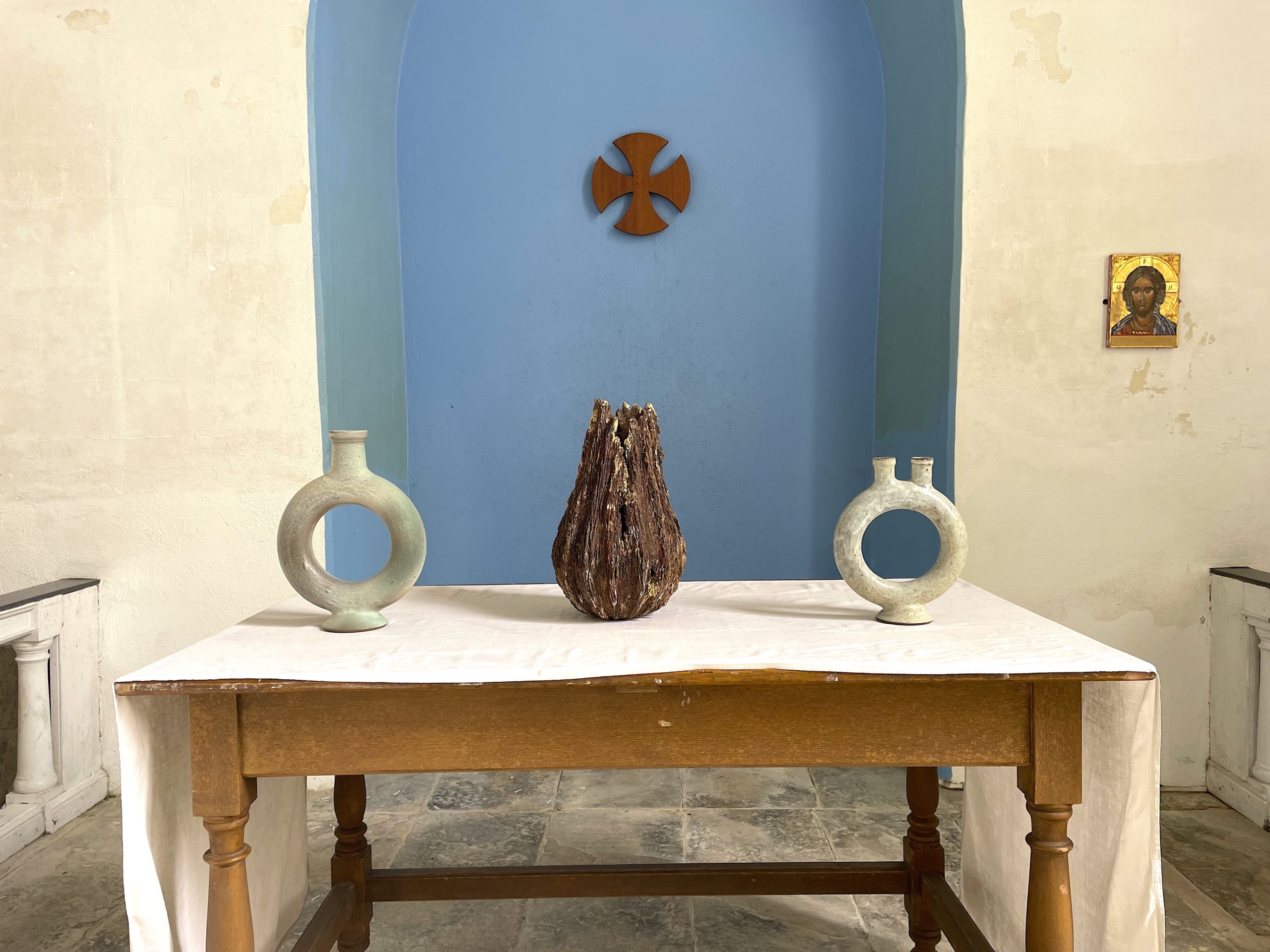
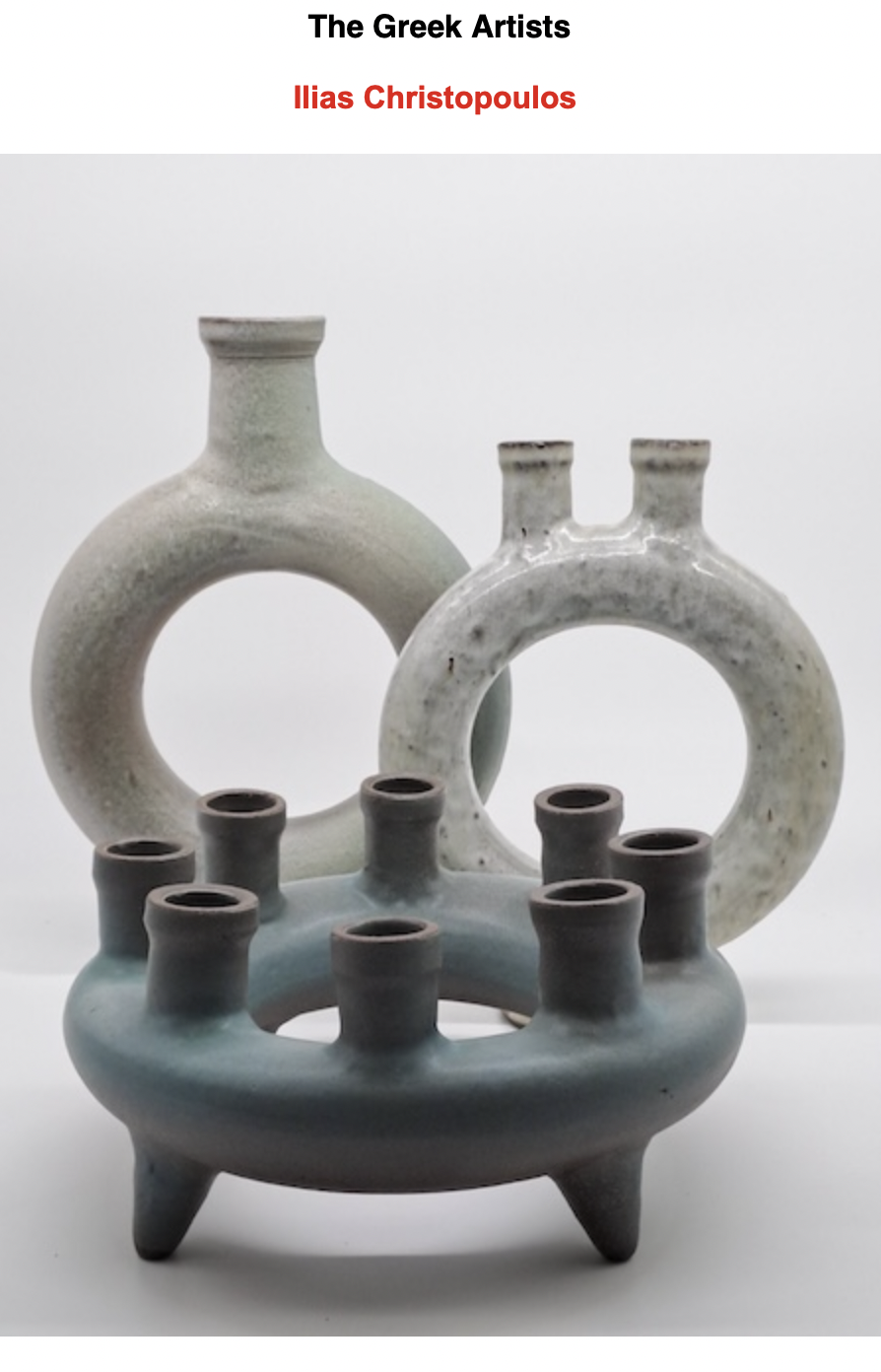
His work is characterized by an adherence to smooth surfaces and perfect wheel-thrown forms. He also frequently creates contemporary or witty versions of traditional and ancient pottery forms. One of his most successful is the reiteration of the ancient Greek ceramic jewelry box – the “pyxida” – into cylindrical porcelain objects with beautifully designed lids. His recent “Ring” vases bring to mind, in their curved shapes and sculptural quality, ancient Greek art most notably the essential, organic simplicity of Cycladic sculpture of the Minoan age.
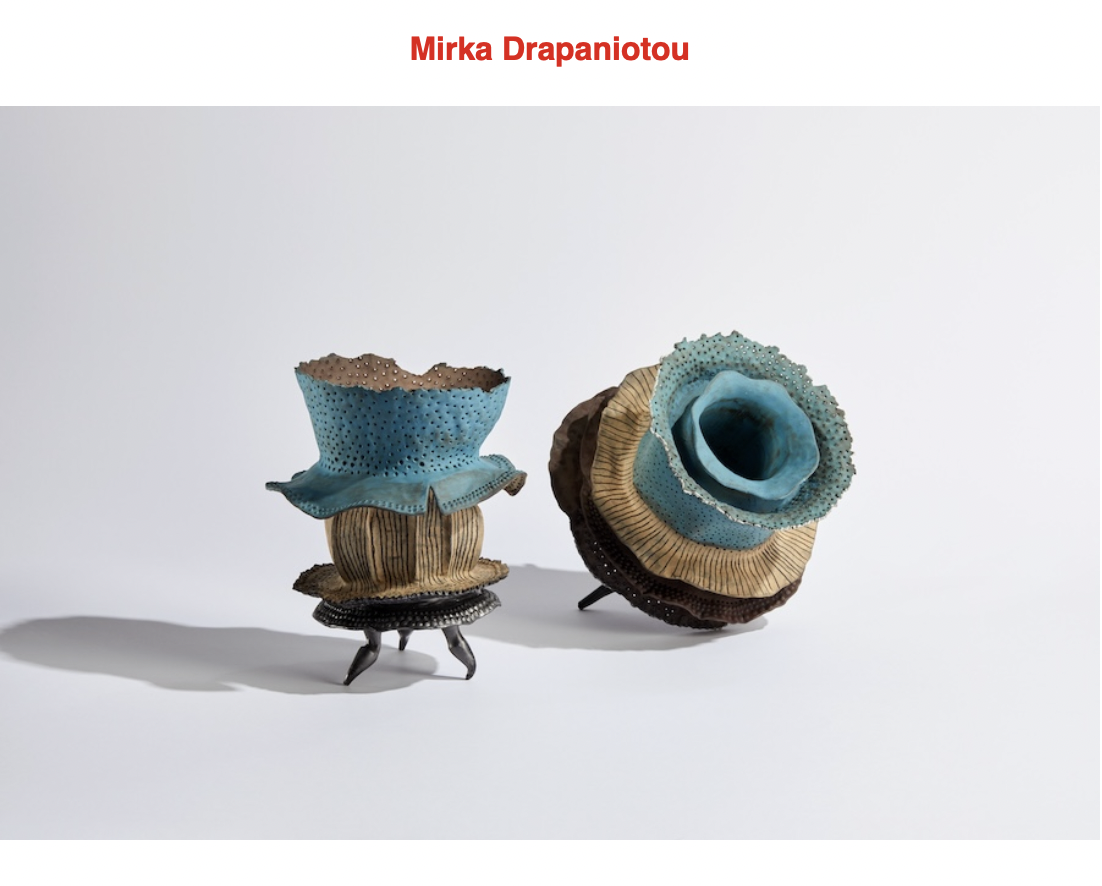
Mirka Drapaniotou studied fashion & clothing design and worked in the fashion industry from 1992 to 2000. In 2012-2017 she studied drawing and colour theory in the studio of painter Eirini Koutridou and in 2018-19 in the studio of Stavros Bonatsos in Athens. She began her studies of ceramics in 2013 with Marilena Mihopoulou and Megandros Papadopoulos and studied at the “Ceramic Forms” school in Athens. In 2014-16 she studied classical sculpture under Altin Patseli and in 2015-17 she studied form-design with the artist and ceramicist Nikos Sklavenitis. Today she works at the “Ceramic Forms” school in Athens and runs her own studio. She is a founding member of the association TERRACTIVA. She is based in Athens and exhibits her work mainly in Greece.
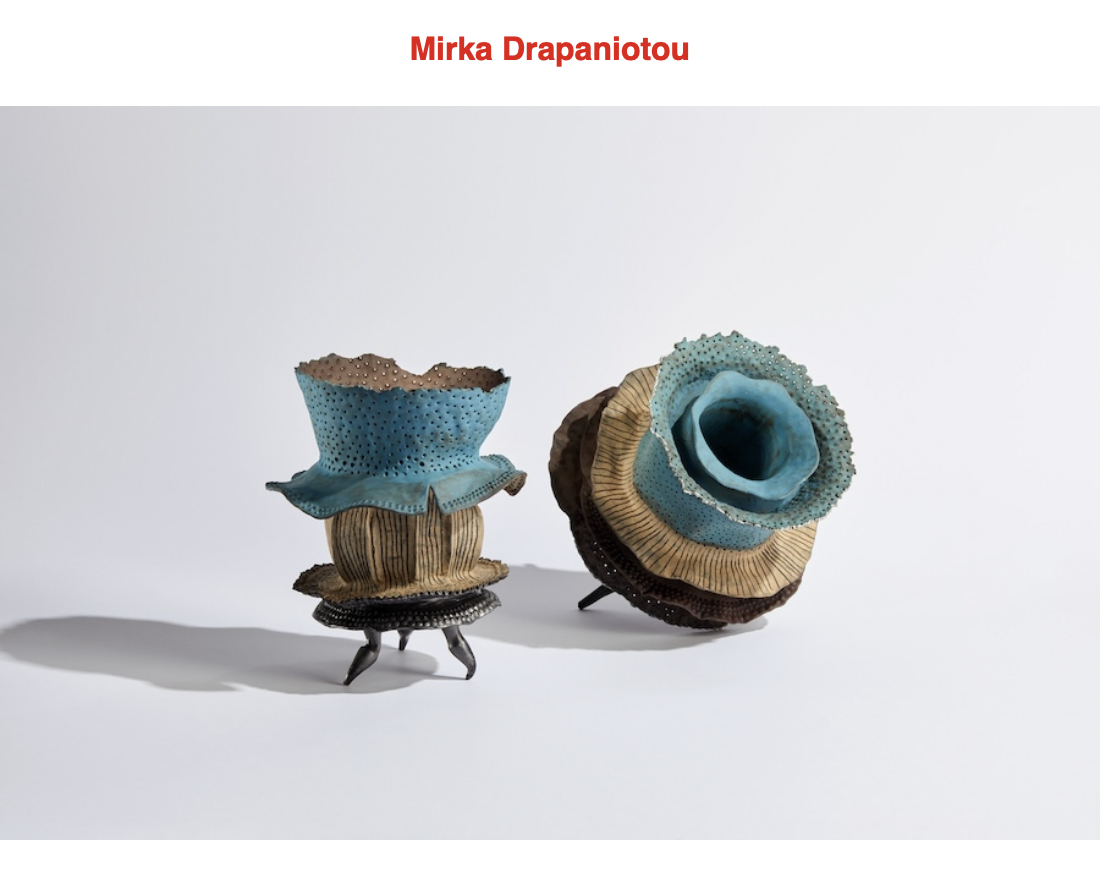
“My initial training was in couture and my working experience for many years was in design and the texture of fabrics. This work encouraged me to explore other materials as well, and I was tempted to try new techniques which in the end lead me to the discovery of the art of ceramics. Clay as a primary and expressive material proved very seductive. Its suppleness and ability to take on form in stages, became for me the essential way to create objects which beyond their aesthetic value also led me to the search for universal forms. My forms are inspired by the Archaic era but are adapted to contemporary life. The geometric elements that constitute my ceramic objects combine harmoniously, and the empty spaces between them as well as the subtle play of light and shade on their surface is as important to me as the object itself.”
Haroula Koropouli is a close associate and a former student of Ilias Christopoulos. She is the founder of the Patra association of ceramicists “Kerameon Ihni” (“Ceramic Trace”s), where she also teaches and runs an important ceramic workshop. She has exhibited widely in Greece notably in the archeological museums of Delphi, Messenia and Patra, Athens, in Paxos but also in Paris and the Biennal Internacional de Ceràmica of Manises in Valencia, Spain.
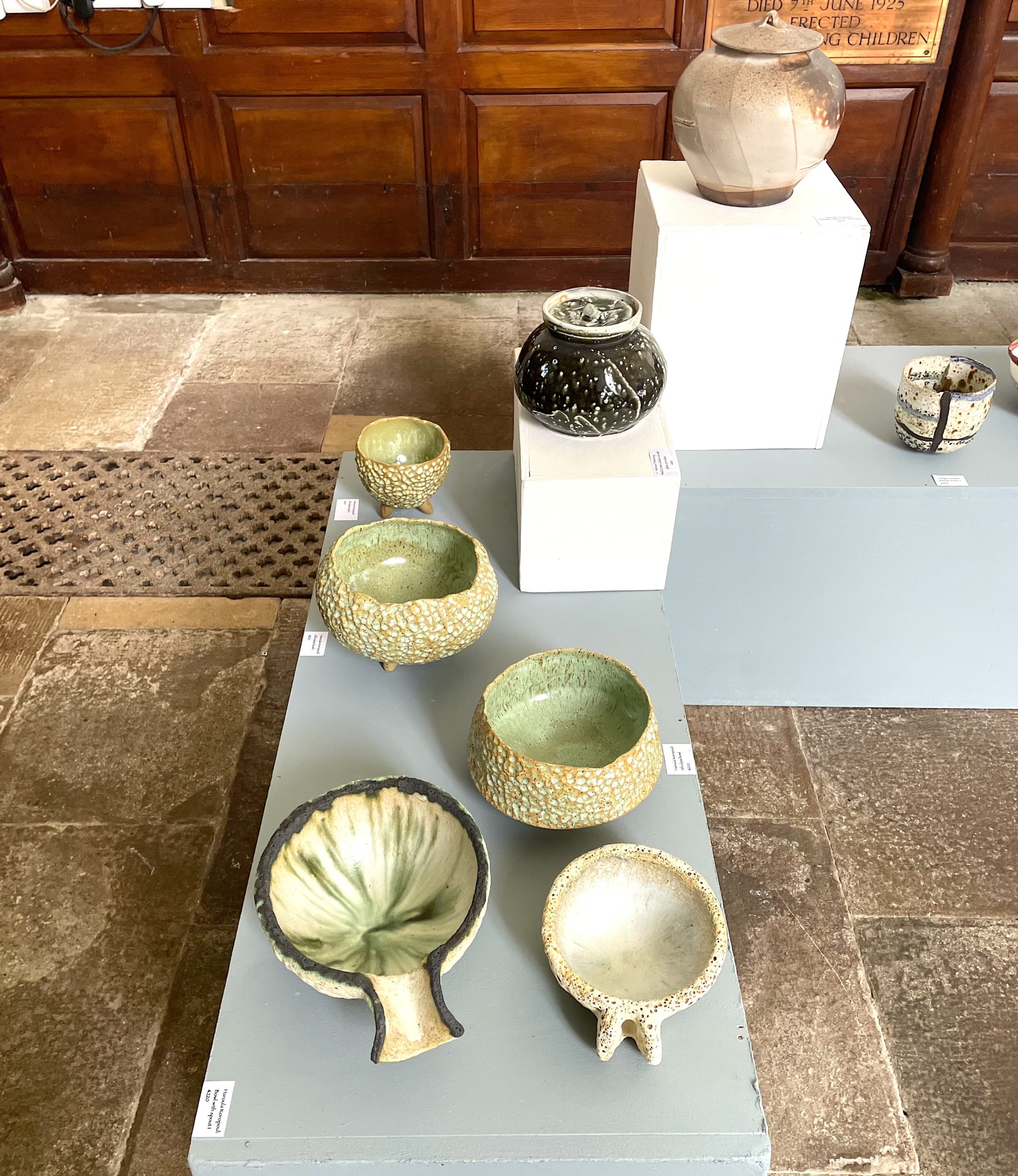
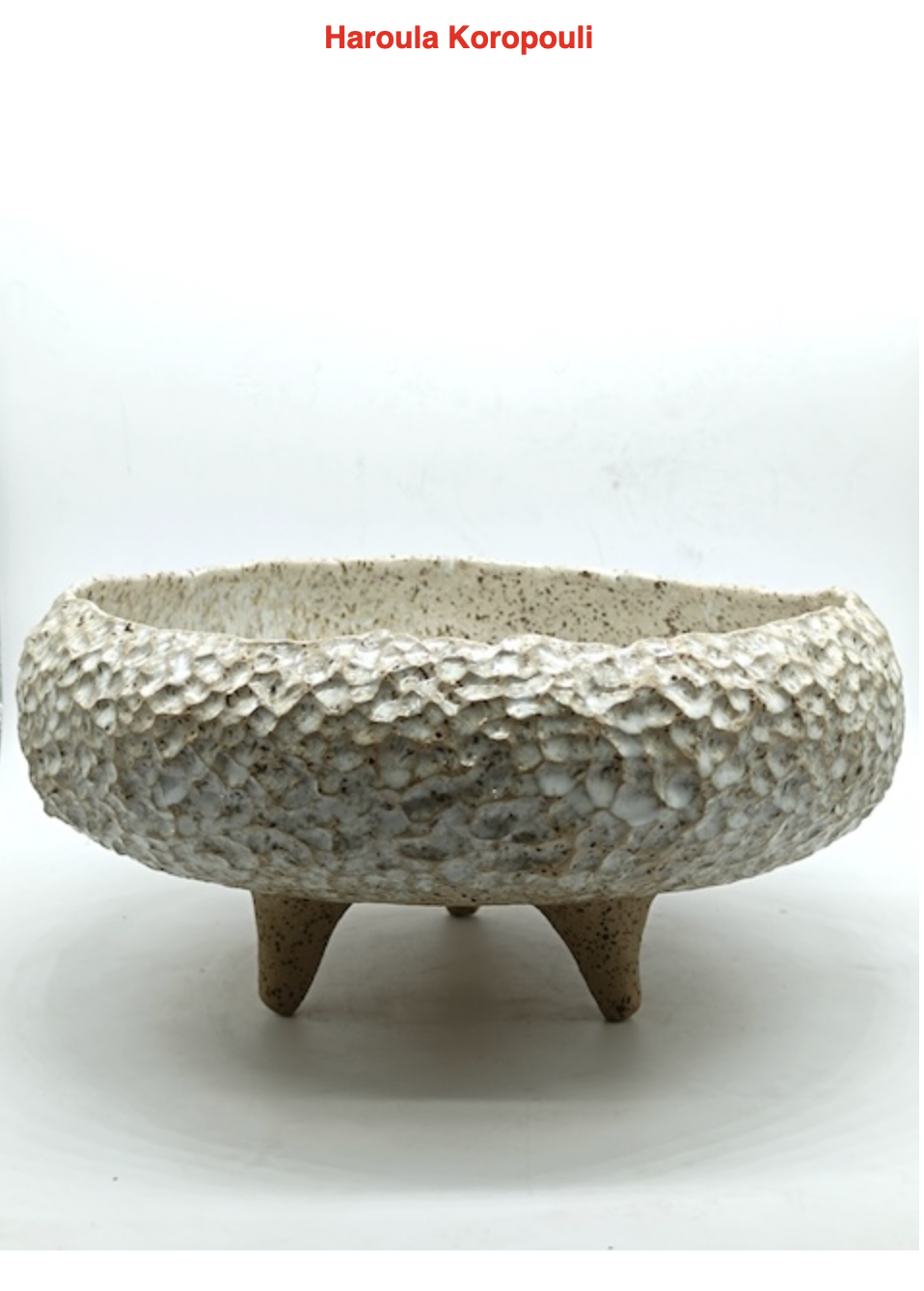
Her work has an organic quality, a sense of density and rusticity that attaches it to the Greek earth. In her latest series of bowls and platters the forms are open and undulating, the surfaces delicately worked with a small hammer as in traditional copperware. The glazes reinforce the earthy origin of the ceramics as they are produced using the ash of olive wood (mauve) and copper (blue green). Yet the delicate tones and the free-flowing forms also have a hint of the Orient, particularly Korean pottery, making her work a sophisticated synthesis of Greek peasant earthiness and Far Eastern grace.
Iosifina Kosma is a Greek ceramic artist living and working in Athens. Her decision to pursue the art of ceramics resulted from the attraction she felt the first moment she experimented with clay at a very young age. After graduating from school, she studied Architecture at the National Technical University of Athens. Her architectural studies had a crucial role in developing her aesthetic. She continued with postgraduate studies in ceramics at Middlesex University, London, where she obtained a Master of Arts with merit.
She has since held three solo exhibitions and participated in many group exhibitions in Greece and internationally. She has participated in international symposia in China, India, Japan, and Turkey. Since 2017 she has been a member of the International Academy of Ceramics, IAC. Her works can be found in private collections in Greece and abroad.
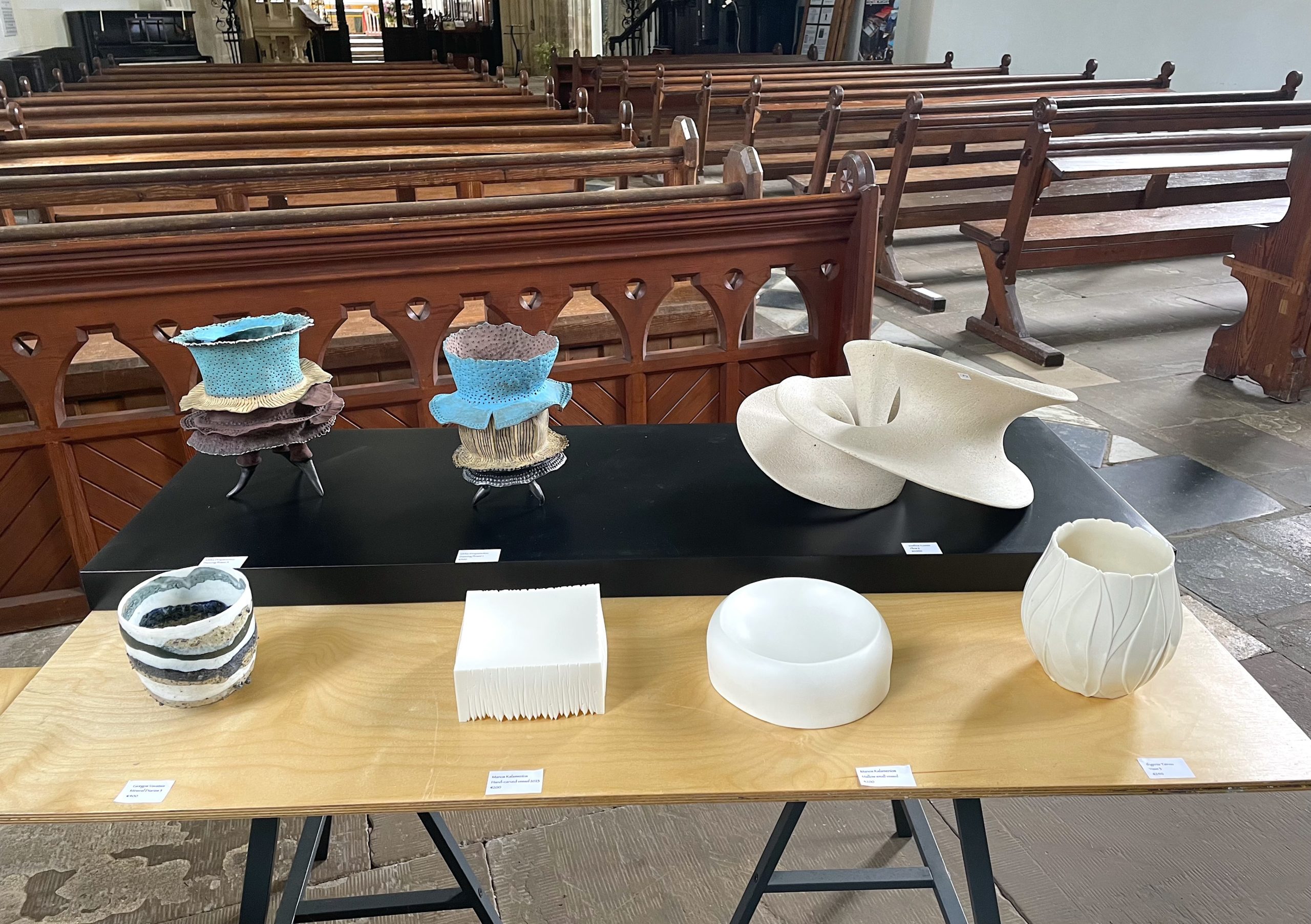
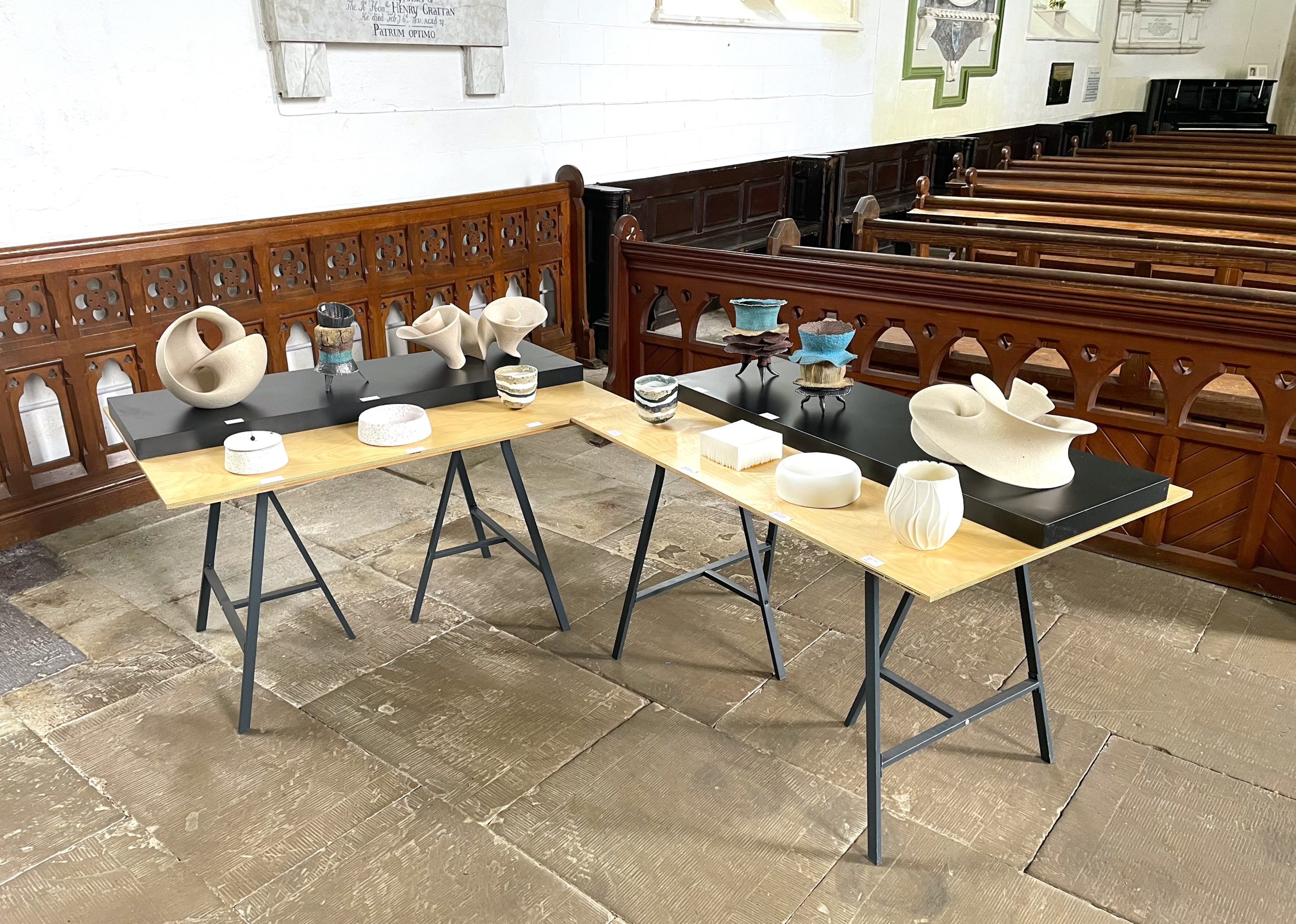
For her latest series – “Flows” – Iosifina creates hand-made abstract, sculptural forms. Working with stoneware clay, she crafts her artworks piece by piece and then connects all the parts together to bring her vision to life. She wishes to make forms that convey feelings of completeness and harmony. Her artworks urge the audience to discover a new aspect each time they look at them from a different angle.
Ifigenia Tsirou was brought up in the beautiful neoclassical town of Nafplio in the Peloponnese. She has lived and worked in Thessaloniki in northern Greece since 1999. She graduated from University of Macedonia, Business Administration Department. She first worked in an advertising company for ten years, before her involvement in ceramics which began in 2006 with her participation in workshops at the Giorgos Vavatsis studio in Thessaloniki.
She has been working as a professional ceramist at Hakah Ceramics Design Production since 2012 (hakahceramics.com) and also teaches adult ceramic workshops in Thessaloniki. She is co-founder of “6exi Contemporary Ceramics” gallery (https://6exiceramics.wordpress.com) in Thessaloniki, where she and Giorgos Vavatsis organize ceramics exhibitions of international and Greek artists. She has exhibited regularly with Chris Boïcos Fine Arts in Paxos, Greece and in France since 2017.
Giorgos Vavatsis is one of the best known contemporary Greek ceramicists. He is based in Thessaloniki and is the founder of Hakah Ceramics Design Production company as a well as the gallery “6 exi – Contemporary Ceramics” devoted to the exhibition of Greek and foreign ceramic artists in Thessaloniki
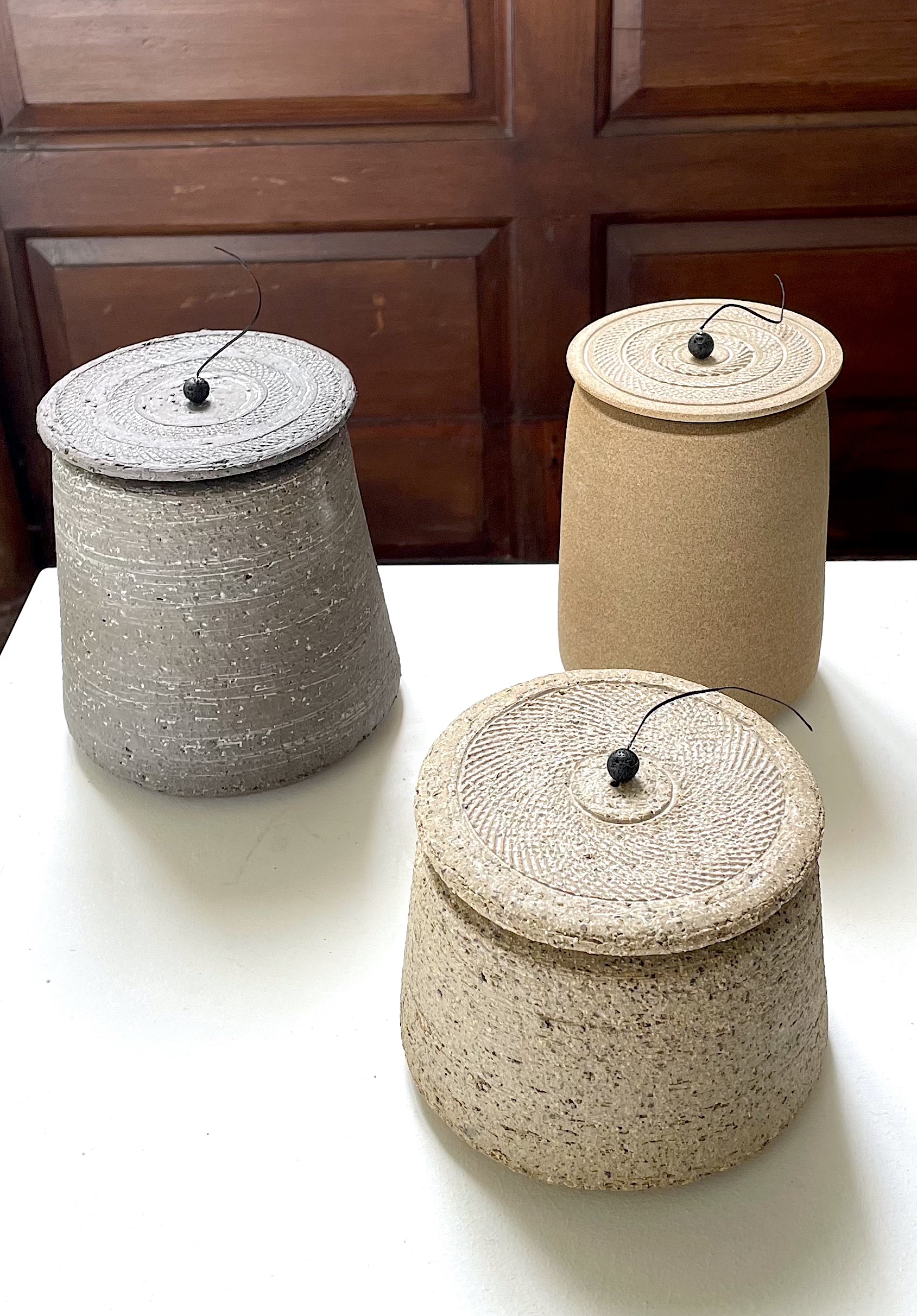
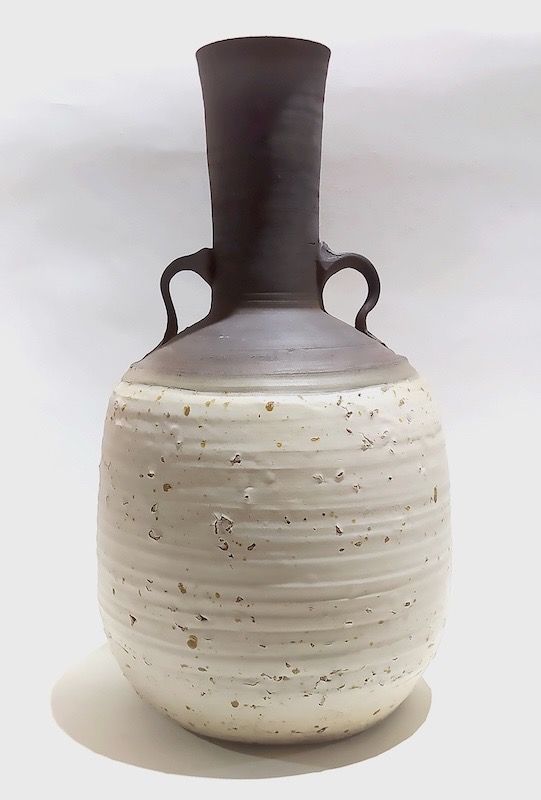
His work is deeply connected to the Greek earth and to the specific places in Greece he visits and loves. He mixes the earth or minerals from these spots into the clay he uses for his “Mineral” series as a way of retaining a physical and symbolic connection between the final ceramic work and the place that inspired it.
Iron refers to mount Hortiatis above Thessaloniki, his native city, iron and aluminum to Delphi the sanctuary of Apollo, while iron and copper were found on the Cycladic island of Serifos. Small lumps of these minerals placed on his pots and vases represent the original material of ceramic art in a pure, unworked state and contrast to the refined, finish of the object to which they are attached. They represent the beginning of the potter’s process, the inspiration and conception that leads to the finalized object.
The subtly imperfect shapes of many of his pots reflect his love for the old peasant bowls (tsoukalia) he discovered, still in use, in old houses on the island of Sifnos. They also recall the conscious imperfection and rugged textures of traditional ancient Korean bowls thus establishing a universal connection between Greek peasant traditions and those of the Far East.
Vavatsis only uses natural or organic glazes, and eschews design, painting and bright color in his work. All his work is also produced on the potter’s wheel and adheres to an ancient and austere discipline of pure ceramic art.
Exhibited artworks (- click on the fotos for details):
 The Very Reverend Paul Draper, Dean of Saint Carthage’s & Rector of Lismore Union has the great pleasure of presenting at Saint Carthage Cathedral in Lismore six prominent Greek ceramicists – Ilias Christopoulos, Mirka Drapaniotou, Haroula Koropouli, Iosifina Kosma, Ifigenia Tsirou, Giorgos Vavatsis – who are exhibiting in Ireland for the first time.
Our Greek guests will be exhibiting in the company of eight well-known Irish colleagues: Isobel Egan, Sinead Fagan, Jane Jermyn, Ann McBride, Marcus O’Mahony, Eileen Singleton, Kathleen Standen & Bernadette Tuite.
The Saint Carthage Cathedral in Lismore:
The Very Reverend Paul Draper, Dean of Saint Carthage’s & Rector of Lismore Union has the great pleasure of presenting at Saint Carthage Cathedral in Lismore six prominent Greek ceramicists – Ilias Christopoulos, Mirka Drapaniotou, Haroula Koropouli, Iosifina Kosma, Ifigenia Tsirou, Giorgos Vavatsis – who are exhibiting in Ireland for the first time.
Our Greek guests will be exhibiting in the company of eight well-known Irish colleagues: Isobel Egan, Sinead Fagan, Jane Jermyn, Ann McBride, Marcus O’Mahony, Eileen Singleton, Kathleen Standen & Bernadette Tuite.
The Saint Carthage Cathedral in Lismore:

 This is a unique opportunity for an Irish audience and the attendants of the 2024 Blackwater Valley Opera Festival in Lismore to discover the variety in form, texture, colour, technique and expressivity of contemporary Greek ceramics.
The same artists will also be exhibiting at the Courthouse Arts Centre in Tinahely, County Wicklow, in July 2024 and at the Old Schoolhouse of Loggos in Paxos, Greece from 5 July to 18 August 2024.
This is a unique opportunity for an Irish audience and the attendants of the 2024 Blackwater Valley Opera Festival in Lismore to discover the variety in form, texture, colour, technique and expressivity of contemporary Greek ceramics.
The same artists will also be exhibiting at the Courthouse Arts Centre in Tinahely, County Wicklow, in July 2024 and at the Old Schoolhouse of Loggos in Paxos, Greece from 5 July to 18 August 2024.
 The project for these three exhibitions – bringing together contemporary Greek and Irish ceramicists in a dynamic creative dialogue – was initiated last summer in an exhibition held in Paxos, Greece during the fifth edition of the annual Irish festival of Paxos – Irish Wings, 2023: Irish and Greek Ceramic Art in Paxos curated by Chris Boïcos and Jane Jermyn.
Since 2017 the Irish Wings festival, under the direction of Kathryn Baird, has brought important Irish contemporary musicians, poets, writers and artists to Paxos in events and exhibitions attended every year by an enthusiastic international audience and by the Irish Ambassador to Greece.
We are delighted to be able to host this unique meeting of international contemporary ceramic art for the first time in Ireland.
The project for these three exhibitions – bringing together contemporary Greek and Irish ceramicists in a dynamic creative dialogue – was initiated last summer in an exhibition held in Paxos, Greece during the fifth edition of the annual Irish festival of Paxos – Irish Wings, 2023: Irish and Greek Ceramic Art in Paxos curated by Chris Boïcos and Jane Jermyn.
Since 2017 the Irish Wings festival, under the direction of Kathryn Baird, has brought important Irish contemporary musicians, poets, writers and artists to Paxos in events and exhibitions attended every year by an enthusiastic international audience and by the Irish Ambassador to Greece.
We are delighted to be able to host this unique meeting of international contemporary ceramic art for the first time in Ireland.
 Ilias Christopoulos is based in Kalamata in the southern Peloponnese. He is a very active member and well-known teacher of the artistic ceramic community in Greece, organizer of symposia and contemporary ceramic art group exhibitions, notably in the archeological museums of Delphi, Patra and Messenia. He is co-founder with Haroula Koropouli of the ceramic artists association “Kerameon Ihni” (“Ceramic Traces”) based in Patra in the Peloponnese. His work has been widely exhibited in Greece and abroad, notably in Italy, Spain, Austria, Hungary, Slovenia and France.
His work is characterized by an adherence to smooth surfaces and perfect wheel-thrown forms. He also frequently creates contemporary or witty versions of traditional and ancient pottery forms. One of his most successful is the reiteration of the ancient Greek ceramic jewelry box – the “pyxida” – into cylindrical porcelain objects with beautifully designed lids. His recent “Ring” vases bring to mind, in their curved shapes and sculptural quality, ancient Greek art most notably the essential, organic simplicity of Cycladic sculpture of the Minoan age.
Ilias Christopoulos is based in Kalamata in the southern Peloponnese. He is a very active member and well-known teacher of the artistic ceramic community in Greece, organizer of symposia and contemporary ceramic art group exhibitions, notably in the archeological museums of Delphi, Patra and Messenia. He is co-founder with Haroula Koropouli of the ceramic artists association “Kerameon Ihni” (“Ceramic Traces”) based in Patra in the Peloponnese. His work has been widely exhibited in Greece and abroad, notably in Italy, Spain, Austria, Hungary, Slovenia and France.
His work is characterized by an adherence to smooth surfaces and perfect wheel-thrown forms. He also frequently creates contemporary or witty versions of traditional and ancient pottery forms. One of his most successful is the reiteration of the ancient Greek ceramic jewelry box – the “pyxida” – into cylindrical porcelain objects with beautifully designed lids. His recent “Ring” vases bring to mind, in their curved shapes and sculptural quality, ancient Greek art most notably the essential, organic simplicity of Cycladic sculpture of the Minoan age.
 Mirka Drapaniotou studied fashion & clothing design and worked in the fashion industry from 1992 to 2000. In 2012-2017 she studied drawing and colour theory in the studio of painter Eirini Koutridou and in 2018-19 in the studio of Stavros Bonatsos in Athens. She began her studies of ceramics in 2013 with Marilena Mihopoulou and Megandros Papadopoulos and studied at the “Ceramic Forms” school in Athens. In 2014-16 she studied classical sculpture under Altin Patseli and in 2015-17 she studied form-design with the artist and ceramicist Nikos Sklavenitis. Today she works at the “Ceramic Forms” school in Athens and runs her own studio. She is a founding member of the association TERRACTIVA. She is based in Athens and exhibits her work mainly in Greece.
“My initial training was in couture and my working experience for many years was in design and the texture of fabrics. This work encouraged me to explore other materials as well, and I was tempted to try new techniques which in the end lead me to the discovery of the art of ceramics. Clay as a primary and expressive material proved very seductive. Its suppleness and ability to take on form in stages, became for me the essential way to create objects which beyond their aesthetic value also led me to the search for universal forms. My forms are inspired by the Archaic era but are adapted to contemporary life. The geometric elements that constitute my ceramic objects combine harmoniously, and the empty spaces between them as well as the subtle play of light and shade on their surface is as important to me as the object itself.”
Mirka Drapaniotou studied fashion & clothing design and worked in the fashion industry from 1992 to 2000. In 2012-2017 she studied drawing and colour theory in the studio of painter Eirini Koutridou and in 2018-19 in the studio of Stavros Bonatsos in Athens. She began her studies of ceramics in 2013 with Marilena Mihopoulou and Megandros Papadopoulos and studied at the “Ceramic Forms” school in Athens. In 2014-16 she studied classical sculpture under Altin Patseli and in 2015-17 she studied form-design with the artist and ceramicist Nikos Sklavenitis. Today she works at the “Ceramic Forms” school in Athens and runs her own studio. She is a founding member of the association TERRACTIVA. She is based in Athens and exhibits her work mainly in Greece.
“My initial training was in couture and my working experience for many years was in design and the texture of fabrics. This work encouraged me to explore other materials as well, and I was tempted to try new techniques which in the end lead me to the discovery of the art of ceramics. Clay as a primary and expressive material proved very seductive. Its suppleness and ability to take on form in stages, became for me the essential way to create objects which beyond their aesthetic value also led me to the search for universal forms. My forms are inspired by the Archaic era but are adapted to contemporary life. The geometric elements that constitute my ceramic objects combine harmoniously, and the empty spaces between them as well as the subtle play of light and shade on their surface is as important to me as the object itself.”
 Haroula Koropouli is a close associate and a former student of Ilias Christopoulos. She is the founder of the Patra association of ceramicists “Kerameon Ihni” (“Ceramic Trace”s), where she also teaches and runs an important ceramic workshop. She has exhibited widely in Greece notably in the archeological museums of Delphi, Messenia and Patra, Athens, in Paxos but also in Paris and the Biennal Internacional de Ceràmica of Manises in Valencia, Spain.
Her work has an organic quality, a sense of density and rusticity that attaches it to the Greek earth. In her latest series of bowls and platters the forms are open and undulating, the surfaces delicately worked with a small hammer as in traditional copperware. The glazes reinforce the earthy origin of the ceramics as they are produced using the ash of olive wood (mauve) and copper (blue green). Yet the delicate tones and the free-flowing forms also have a hint of the Orient, particularly Korean pottery, making her work a sophisticated synthesis of Greek peasant earthiness and Far Eastern grace.
Haroula Koropouli is a close associate and a former student of Ilias Christopoulos. She is the founder of the Patra association of ceramicists “Kerameon Ihni” (“Ceramic Trace”s), where she also teaches and runs an important ceramic workshop. She has exhibited widely in Greece notably in the archeological museums of Delphi, Messenia and Patra, Athens, in Paxos but also in Paris and the Biennal Internacional de Ceràmica of Manises in Valencia, Spain.
Her work has an organic quality, a sense of density and rusticity that attaches it to the Greek earth. In her latest series of bowls and platters the forms are open and undulating, the surfaces delicately worked with a small hammer as in traditional copperware. The glazes reinforce the earthy origin of the ceramics as they are produced using the ash of olive wood (mauve) and copper (blue green). Yet the delicate tones and the free-flowing forms also have a hint of the Orient, particularly Korean pottery, making her work a sophisticated synthesis of Greek peasant earthiness and Far Eastern grace.
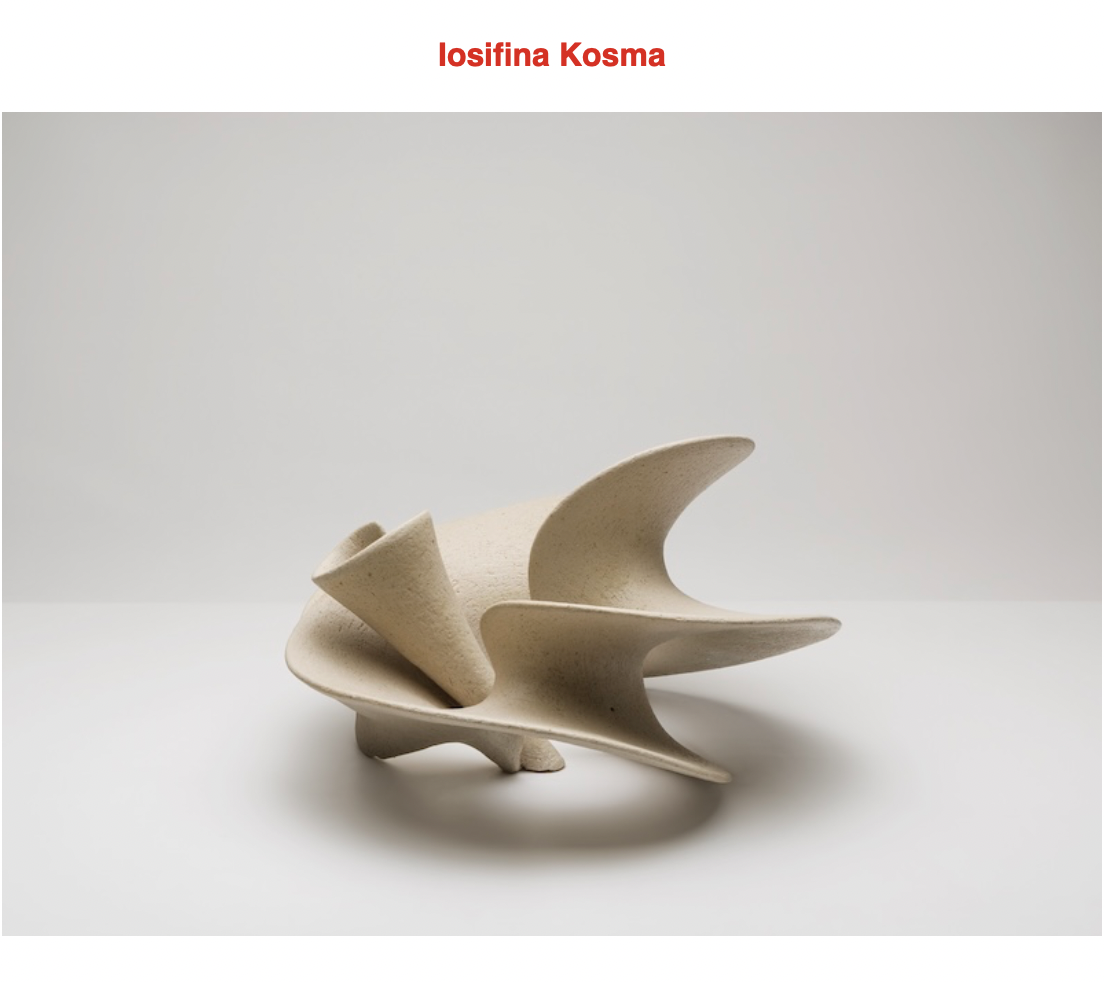 Iosifina Kosma is a Greek ceramic artist living and working in Athens. Her decision to pursue the art of ceramics resulted from the attraction she felt the first moment she experimented with clay at a very young age. After graduating from school, she studied Architecture at the National Technical University of Athens. Her architectural studies had a crucial role in developing her aesthetic. She continued with postgraduate studies in ceramics at Middlesex University, London, where she obtained a Master of Arts with merit.
She has since held three solo exhibitions and participated in many group exhibitions in Greece and internationally. She has participated in international symposia in China, India, Japan, and Turkey. Since 2017 she has been a member of the International Academy of Ceramics, IAC. Her works can be found in private collections in Greece and abroad.
For her latest series – “Flows” – Iosifina creates hand-made abstract, sculptural forms. Working with stoneware clay, she crafts her artworks piece by piece and then connects all the parts together to bring her vision to life. She wishes to make forms that convey feelings of completeness and harmony. Her artworks urge the audience to discover a new aspect each time they look at them from a different angle.
Iosifina Kosma is a Greek ceramic artist living and working in Athens. Her decision to pursue the art of ceramics resulted from the attraction she felt the first moment she experimented with clay at a very young age. After graduating from school, she studied Architecture at the National Technical University of Athens. Her architectural studies had a crucial role in developing her aesthetic. She continued with postgraduate studies in ceramics at Middlesex University, London, where she obtained a Master of Arts with merit.
She has since held three solo exhibitions and participated in many group exhibitions in Greece and internationally. She has participated in international symposia in China, India, Japan, and Turkey. Since 2017 she has been a member of the International Academy of Ceramics, IAC. Her works can be found in private collections in Greece and abroad.
For her latest series – “Flows” – Iosifina creates hand-made abstract, sculptural forms. Working with stoneware clay, she crafts her artworks piece by piece and then connects all the parts together to bring her vision to life. She wishes to make forms that convey feelings of completeness and harmony. Her artworks urge the audience to discover a new aspect each time they look at them from a different angle.
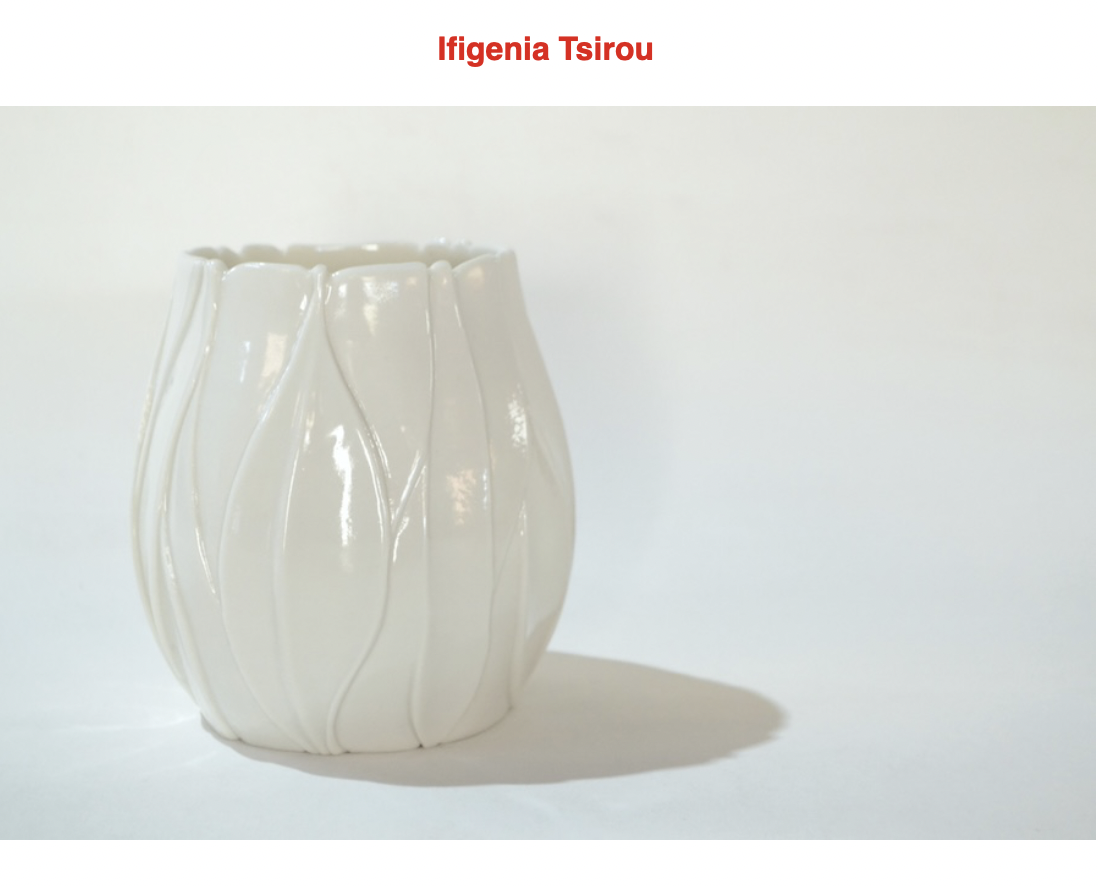 Ifigenia Tsirou was brought up in the beautiful neoclassical town of Nafplio in the Peloponnese. She has lived and worked in Thessaloniki in northern Greece since 1999. She graduated from University of Macedonia, Business Administration Department. She first worked in an advertising company for ten years, before her involvement in ceramics which began in 2006 with her participation in workshops at the Giorgos Vavatsis studio in Thessaloniki.
She has been working as a professional ceramist at Hakah Ceramics Design Production since 2012 (hakahceramics.com) and also teaches adult ceramic workshops in Thessaloniki. She is co-founder of “6exi Contemporary Ceramics” gallery (https://6exiceramics.wordpress.com) in Thessaloniki, where she and Giorgos Vavatsis organize ceramics exhibitions of international and Greek artists. She has exhibited regularly with Chris Boïcos Fine Arts in Paxos, Greece and in France since 2017.
Ifigenia Tsirou was brought up in the beautiful neoclassical town of Nafplio in the Peloponnese. She has lived and worked in Thessaloniki in northern Greece since 1999. She graduated from University of Macedonia, Business Administration Department. She first worked in an advertising company for ten years, before her involvement in ceramics which began in 2006 with her participation in workshops at the Giorgos Vavatsis studio in Thessaloniki.
She has been working as a professional ceramist at Hakah Ceramics Design Production since 2012 (hakahceramics.com) and also teaches adult ceramic workshops in Thessaloniki. She is co-founder of “6exi Contemporary Ceramics” gallery (https://6exiceramics.wordpress.com) in Thessaloniki, where she and Giorgos Vavatsis organize ceramics exhibitions of international and Greek artists. She has exhibited regularly with Chris Boïcos Fine Arts in Paxos, Greece and in France since 2017.
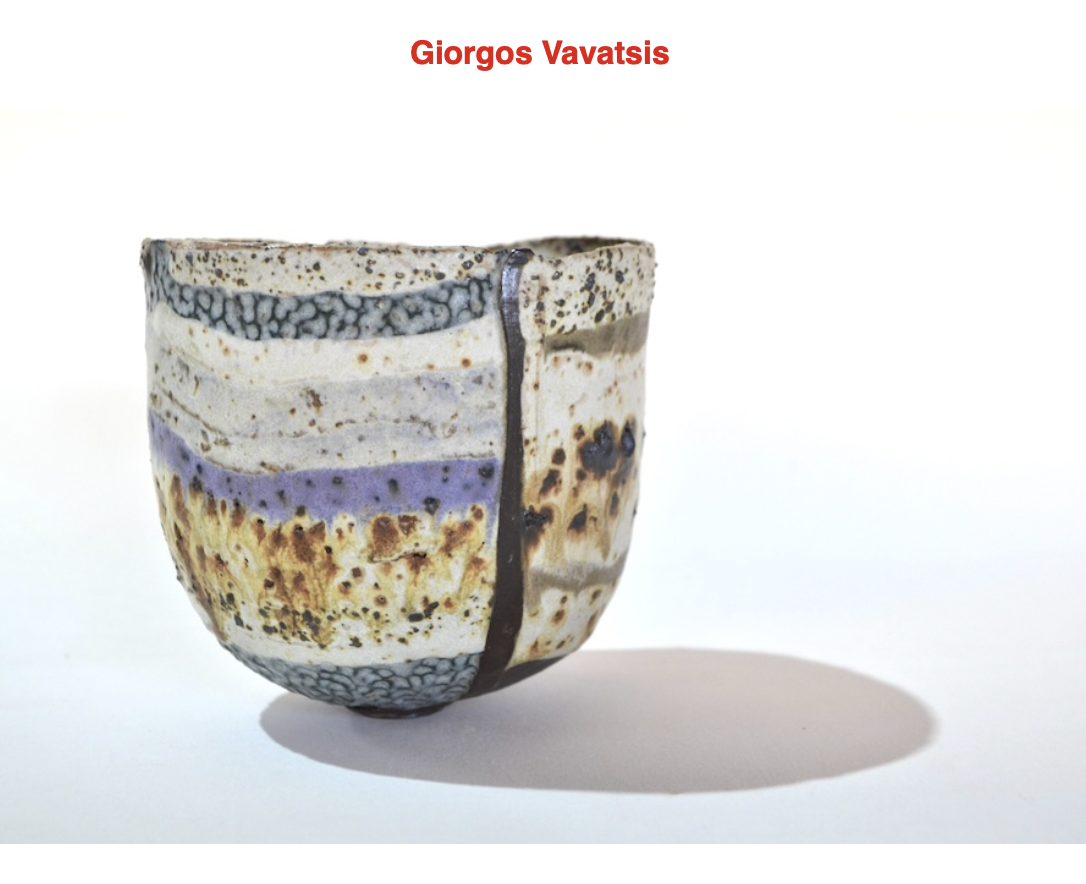 Giorgos Vavatsis is one of the best known contemporary Greek ceramicists. He is based in Thessaloniki and is the founder of Hakah Ceramics Design Production company as a well as the gallery “6 exi – Contemporary Ceramics” devoted to the exhibition of Greek and foreign ceramic artists in Thessaloniki
His work is deeply connected to the Greek earth and to the specific places in Greece he visits and loves. He mixes the earth or minerals from these spots into the clay he uses for his “Mineral” series as a way of retaining a physical and symbolic connection between the final ceramic work and the place that inspired it.
Iron refers to mount Hortiatis above Thessaloniki, his native city, iron and aluminum to Delphi the sanctuary of Apollo, while iron and copper were found on the Cycladic island of Serifos. Small lumps of these minerals placed on his pots and vases represent the original material of ceramic art in a pure, unworked state and contrast to the refined, finish of the object to which they are attached. They represent the beginning of the potter’s process, the inspiration and conception that leads to the finalized object.
The subtly imperfect shapes of many of his pots reflect his love for the old peasant bowls (tsoukalia) he discovered, still in use, in old houses on the island of Sifnos. They also recall the conscious imperfection and rugged textures of traditional ancient Korean bowls thus establishing a universal connection between Greek peasant traditions and those of the Far East.
Vavatsis only uses natural or organic glazes, and eschews design, painting and bright color in his work. All his work is also produced on the potter’s wheel and adheres to an ancient and austere discipline of pure ceramic art.
Exhibited artworks (- click on the fotos for details):
Giorgos Vavatsis is one of the best known contemporary Greek ceramicists. He is based in Thessaloniki and is the founder of Hakah Ceramics Design Production company as a well as the gallery “6 exi – Contemporary Ceramics” devoted to the exhibition of Greek and foreign ceramic artists in Thessaloniki
His work is deeply connected to the Greek earth and to the specific places in Greece he visits and loves. He mixes the earth or minerals from these spots into the clay he uses for his “Mineral” series as a way of retaining a physical and symbolic connection between the final ceramic work and the place that inspired it.
Iron refers to mount Hortiatis above Thessaloniki, his native city, iron and aluminum to Delphi the sanctuary of Apollo, while iron and copper were found on the Cycladic island of Serifos. Small lumps of these minerals placed on his pots and vases represent the original material of ceramic art in a pure, unworked state and contrast to the refined, finish of the object to which they are attached. They represent the beginning of the potter’s process, the inspiration and conception that leads to the finalized object.
The subtly imperfect shapes of many of his pots reflect his love for the old peasant bowls (tsoukalia) he discovered, still in use, in old houses on the island of Sifnos. They also recall the conscious imperfection and rugged textures of traditional ancient Korean bowls thus establishing a universal connection between Greek peasant traditions and those of the Far East.
Vavatsis only uses natural or organic glazes, and eschews design, painting and bright color in his work. All his work is also produced on the potter’s wheel and adheres to an ancient and austere discipline of pure ceramic art.
Exhibited artworks (- click on the fotos for details):